

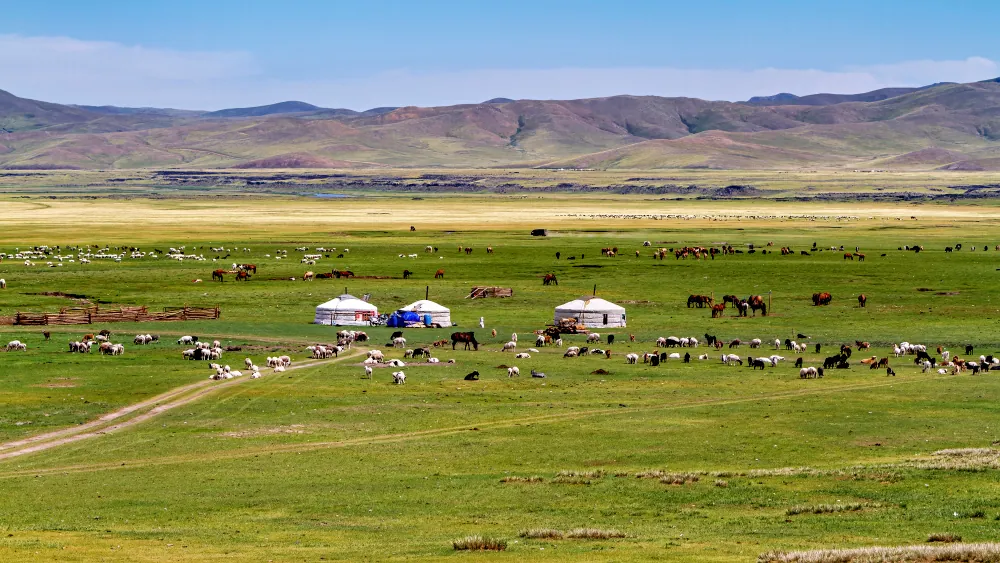
The United Nations General Assembly has proclaimed 2026 the International Year for Rangelands and Pastoralists (IYRP) in response to a proposal from the Government of Mongolia. IYRP 2026 aims to raise global awareness of the vital roles that rangelands and pastoralists play in food security, climate adaptation and mitigation, ecosystem health and sustainable rural livelihoods.
Pastoralists, people who depend on livestock and practice some degree of mobility with their animals, are found across the world, including Africa, Asia, the Middle East and South America. Although estimates are difficult, the FAO estimates that at least 180 million pastoralists manage approximately one billion domestic animals. In doing so, they also steward rangelands covering around half of the earth’s land area, thus importantly, producing food, other goods and services and securing their own livelihoods in lands too dry, cold or mountainous for crop production.
Despite its contribution to livelihoods and ecosystem services, pastoralism is widely misunderstood as unsustainable. Pastoralists are often marginalised economically, politically and culturally, and even find themselves in conflict zones. There is a need for policies that recognise pastoralists’ management of rangelands, support mobility, and reduce regulatory, economic and infrastructural barriers to marketing animals and animal products.
NRI has a long record in pastoralism research and consultancy, covering work on topics including drought management, pastoral politics, the private sector in pastoral development, and major programme evaluations. Current and recent examples span East and West Africa and Mongolia:
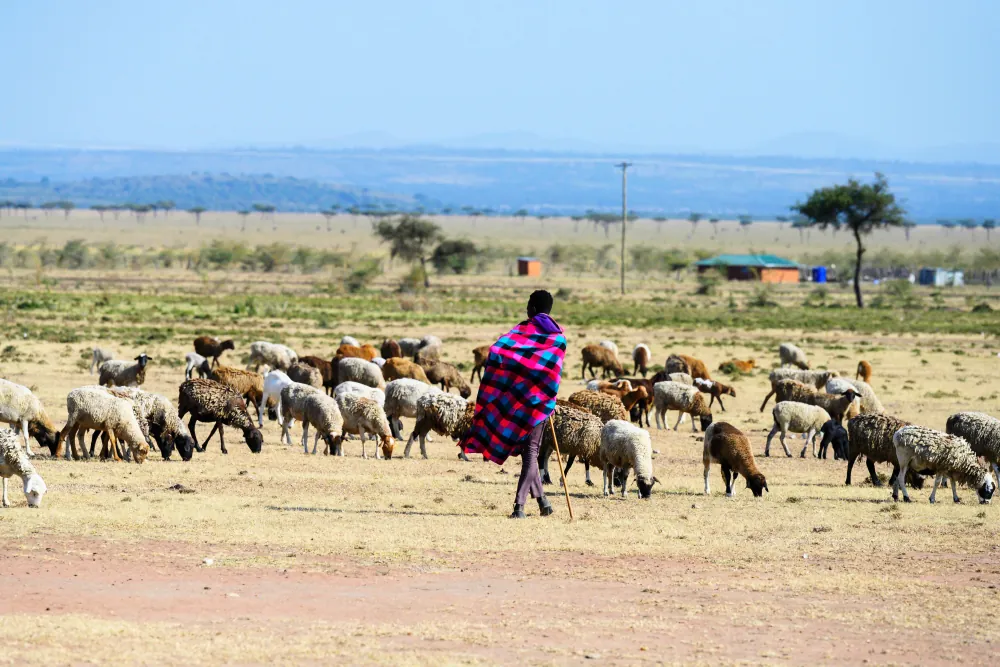
NRI’s Professor John Morton works as Team Leader for Technical Assistance and Third-Party Monitoring of PLACE (Pastoralism and Livestock Adaptation to Climate Change in Eastern Africa), a €47 million EU-funded programme implemented by FAO. The programme aims to improve climate resilience and foster sustainable development among pastoralists in East Africa, particularly in areas where pastoralists migrate or trade across national frontiers – areas that may also be prone to conflict. Interventions include provision of water infrastructure, livestock vaccination campaigns, policy and advocacy work, cross-border dialogues, and community-led peace forums. Professor Morton and his colleagues are independently contracted by the EU to monitor delivery of programme outputs, review aspects of pastoralist development and for knowledge management among the PLACE partners and other stakeholders.
Pastoralists in northern Kenya and Somalia engage in camel herding and camel milk production. Through an Innovate UK-funded project, NRI researchers Dr June Po and Dr Aditya Parmar have supported camel milk value chains in northern Kenya, in collaboration with Anolei Women’s Camel Milk Cooperative and Egerton University. This NRI-led project strengthened post-harvest value chains and advanced the Cooperative’s product development and business literacy, helping it diversify into camel yoghurt products, scale operations, and improve business literacy under climate and conflict contexts. Still, barriers to women’s participation in formal training and capacity building, external-facing leadership, knowledge exchange, and governance remain.
Research by NRI PhD student, Rejoice Papka, supervised by Dr Uche Okpara under Uche’s UKRI Future Leaders Fellowship, examines how pastoralists in the Lake Chad region navigate conflict and worsening drought that have destroyed pastures and degraded water resources. Years of fighting and climate change have not only killed animals and cut incomes but have also broken trust between herders, weakened traditional dialogue and conflict resolution systems, and crucially, disrupted indigenous pastoral knowledge systems. Insurgency and cattle-rustling block many migration and grazing routes, while unpredictable droughts often destroy pasture, increasing vulnerability and forcing 90% of herders to rely on aid. These cascading shocks hit even harder by eroding the social and cultural foundations that once made pastoralists resilient. The remaining 10% of herders adapt by finding alternative routes, rebuilding social ties, and leveraging remaining knowledge to sustain their herds.
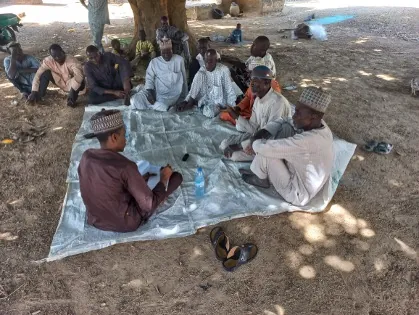
NRI PhD student, Dr Abubakar Ibrahim was recently awarded a PhD for his thesis on “Comparative Vulnerability Assessment for Strengthening Adaptive Capacity and Food Security of Rural Communities in Kebbi State, Northern Nigeria”. Abubakar used qualitative and quantitative methods to compare pastoralists in Northern Nigeria with two other groups, dryland crop farmers and artisanal fisherfolk, analysing drivers and consequences of vulnerability, adaptation strategies, and the cultural, socioeconomic and institutional factors influencing those strategies.
Professor Morton also worked as a Social Sector Specialist and Team Leader for a study of cashmere in Mongolia under the Value Chain Analysis for Development (VCA4D) project. Cashmere, the extremely fine wool from the undercoat of certain goat breeds, is crucial for the livelihoods of 190,000 herding families who constitute the majority of Mongolia’s rural population and are custodians of its cultural identity. The team confirmed interlocking threats to the cashmere value chain, including overgrazing, declining fibre quality, and competition for raw cashmere from China. Initiatives to certify Mongolian cashmere for export markets, based on both fibre quality and sustainable rangeland use, are promising but need harmonisation.
We hope the IYRP will raise the profile of pastoralism and contribute to a better policy environment for development for and with pastoralists.
Selected NRI Publications on Pastoralism
Fadare, O., Srinivasan, C., & Zanello, G. (2024). “Livestock diversification mitigates the impact of farmer-herder conflicts on animal-source foods consumption in Nigeria”. Food Policy, 122, 102586. https://doi.org/10.1016/j.foodpol.2023.102586
Morton, J. (2023). “Pastoralism” in M. Clarke and X. Zhang (eds.) Elgar Encyclopaedia of Development, Elgar. https://doi.org/10.4337/9781800372122.ch97
Hunduma, D., Amenu, K., Desta, H., Grace, D., Agga, G. E., & Kerro Dego, O. (2023). Prevalence and antimicrobial resistance of Escherichia coli O157: H7 and Salmonella, and the prevalence of Staphylococcus aureus in dairy cattle and camels under pastoral production system. Antibiotics, 13(1), 26. https://doi.org/10.3390/antibiotics13010026
Snaibi, W., Mezrhab, A., Sy, O., & Morton, J. (2021) “Perception and adaptation of pastoralists to climate variability and change in Morocco's arid rangelands”. Heliyon, 7(11), e08434 (2021). 10.1016/j.heliyon.2021.e08434
Ripkey, C., Little, P. D., Dominguez-Salas, P., Kinabo, J., Mwanri, A., & Girard, A. W. (2021). Increased climate variability and sedentarization in Tanzania: Health and nutrition implications on pastoral communities of Mvomero and Handeni districts, Tanzania. Global Food Security, 29, 100516. https://doi.org/10.1016/j.gfs.2021.100516
Mayanja, M. N., Rubaire-Akiiki, C., Morton, J., and Kabasa, J. D. (2019). “Pastoral Community Coping and Adaptation Strategies to Manage Household Food Insecurity consequent to Climatic Hazards in the Cattle Corridor of Uganda”. Climate and Development, 1-10. https://doi.org/10.1080/17565529.2019.1605283
López-i-Gelats, F., Fraser, E., Morton, J. and Rivera-Ferre, M. (2016). “What Drives Pastoralists' Vulnerability to Global Environmental Change? Pathways of Vulnerability”. Global Environmental Change 39: 258-274. https://doi.org/10.1016/j.gloenvcha.2016.05.011
Nelson, V., Forsythe, L., & Morton, J. (2015). Empowering dryland women: capturing opportunities in land rights, governance and resilience. Synthesis of thematic papers from the series ‘Women’s empowerment in the drylands’. NRI Report for UNDP. https://www.undp.org/sites/g/files/zskgke326/files/publications/Dryland%20women%20Synthesis.pdf
Morton, J. (2013). “‘Responsible Companies’ and African Livestock-Keepers: Helping, teaching but not learning?”. In Pastoralism and Development in Africa (pp. 108-118). Routledge. https://library.oapen.org/handle/20.500.12657/102413
Morton, J. (2010). “Why should governmentality matter for the study of pastoral development?”. Nomadic Peoples, 14(1), 6-30. https://www.liverpooluniversitypress.co.uk/doi/pdf/10.3167/np.2010.140102