

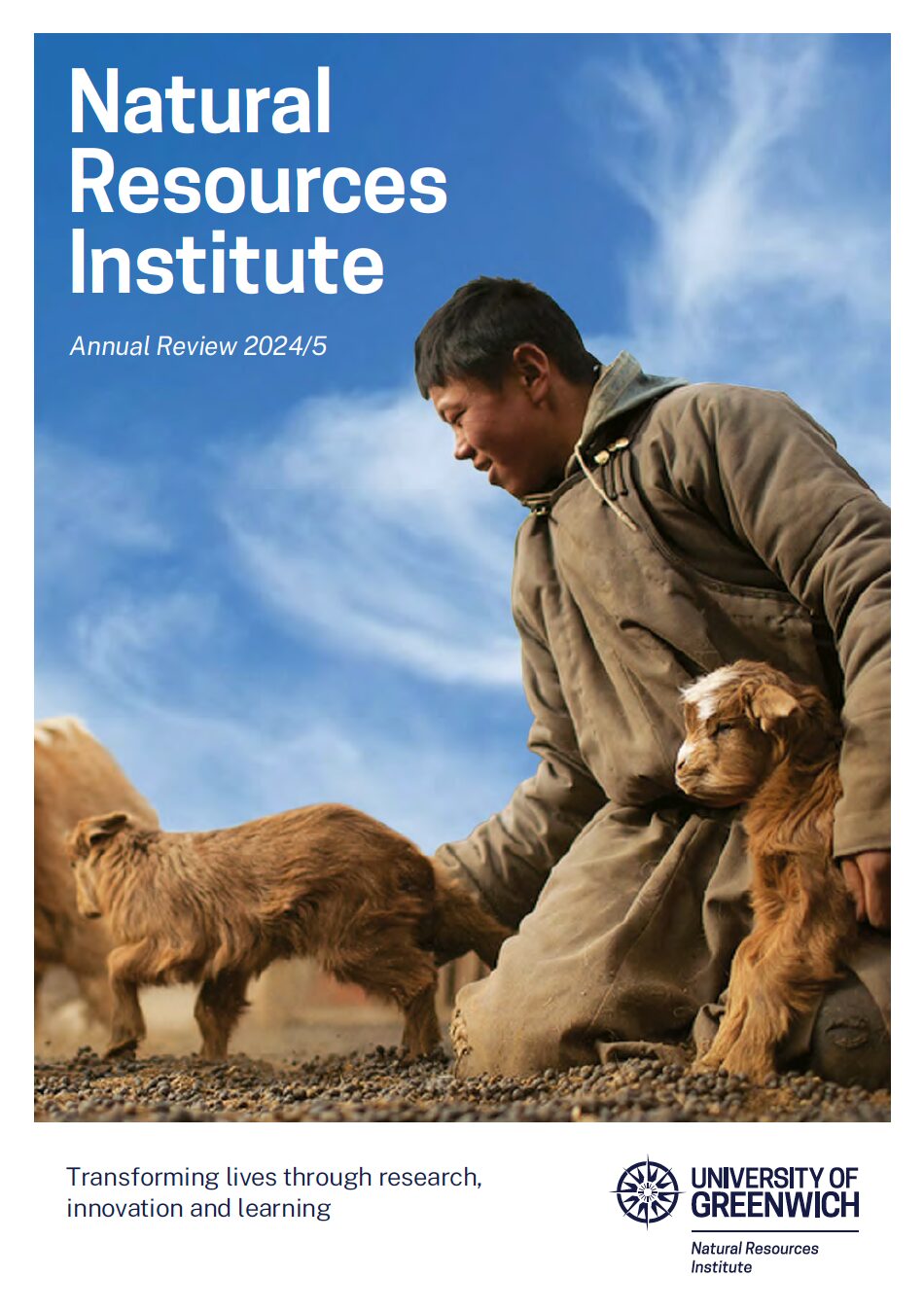
The Natural Resources Institute (NRI) is pleased to share its Annual Review 2025, presenting highlights from a year defined by impact, innovation and global collaboration. The publication brings together stories from across NRI’s research, partnerships and teaching, demonstrating how interdisciplinary science is contributing to more sustainable, equitable and resilient food systems, livelihoods and environments worldwide.
The Review illustrates the breadth of our work and captures the multiple ways this work makes a difference across geographies and disciplines. In Ghana, specialised entomology training for participants from six countries – Benin, Cameroon, Ghana, Mozambique, the UK and the USA – helped strengthen capacity to support the elimination of river blindness. Research with partners in Côte d’Ivoire has advanced understanding of cashew anthracnose, a devastating disease of cashew trees, opening pathways towards better disease management and development of disease-resistant cashew varieties. Research on Mongolia’s cashmere value chain has produced valuable insights to help balance environmental sustainability with economic opportunity for approximately 190,000 herding families, whose livelihoods depend on this high-value commodity.
Public health, nutrition and social equity feature strongly throughout the review. Our work in Nigeria with the University of Reading has shed light on the mitigating impact of livestock diversification and animal-source food consumption on the effects of farmer-herder conflict in the country’s middle belt. This research provides a crucial pathway to safeguard positive nutrition outcomes in a region grappling with the twin effects of climate change and persistent conflict. In Madagascar, NRI researchers and their collaborators have developed and validated a simplified, adaptable tool to measure women’s empowerment in multisectoral agriculture and nutrition programmes, supporting more effective monitoring and evaluation. The Review also showcases influential work on wild meat value chains, contributing to global debates on food safety, biodiversity and the right to food.
Innovation and interdisciplinary approaches are a recurring theme. The RedRoz project is demonstrating how community-led rodent control can reduce disease risk and improve household wellbeing in Tanzania and Madagascar. In the UK, cutting-edge research integrating sensor technology, artificial intelligence and plant chemistry is informing approaches to optimise pollination in greenhouses, while new smart trapping technologies are contributing to the development of tools to enhance pest surveillance and real-time detection. Sustainable agriculture initiatives, including the development of a plant-based pesticide derived from croton seed oil in Kenya, further illustrate how research can deliver environmentally responsible and locally relevant solutions.
The Review also reflects NRI’s ongoing commitment to capacity building and knowledge exchange. Through initiatives such as the Food Accelerator Programme and industrial practice MScs, students, innovators and entrepreneurs are gaining hands-on experience, technical skills and pathways into impactful careers, while international collaborations remain central to our research, networks and shared learning.
The NRI Annual Review 2025 provides an engaging overview of how collaborative, evidence-based research and inclusive partnerships are addressing complex global challenges. It also highlights our continued efforts to co-create practical solutions that improve lives, inform policy and support a more just and sustainable future.