

Countries are not on track to achieve the 2030 Agenda for Sustainable Development. Progress across the Sustainable Development Goals (SDGs) has been uneven, often undermined by siloed implementation that overlooks the complex synergies and trade-offs between social, economic and environmental objectives. Recent global shocks, including the COVID-19 pandemic and geopolitical tensions, have further slowed momentum.
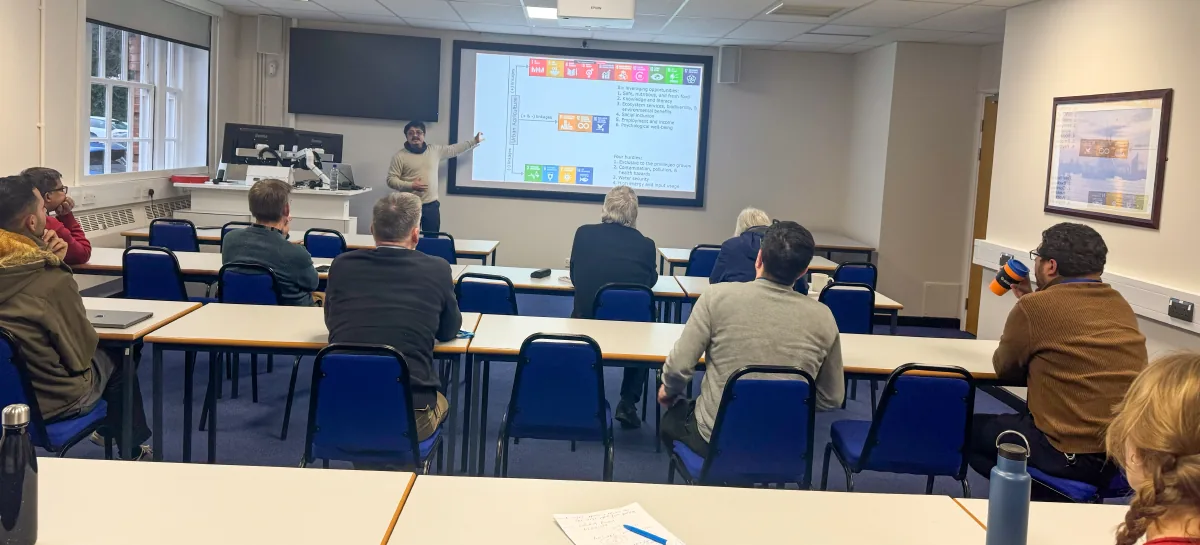
These challenges were the focus of an NRI research seminar held on 26 January, delivered by Dr Prajal Pradhan, a Coordinating Lead Author of the Intergovernmental Panel on Climate Change (IPCC) Seventh Assessment Report (Working Group III). In his talk, A threefold approach for the acceleration of Sustainable Development Goals and beyond, Dr Pradhan examined why the SDGs are struggling to deliver transformative change and what science can do in the critical years ahead.
Dr Pradhan began by revisiting the foundations of sustainable development, emphasising that sustainability has long been understood as a balance between present needs and future limits. Today, this principle underpins the 17 SDGs and their 169 targets. Yet their integrated and indivisible nature remains one of the greatest implementation challenges. Goals interact differently depending on context, producing both synergies and trade-offs that are often poorly accounted for in policy and planning.
For example, improving sanitation can reduce under-five mortality, creating positive spillovers across goals. At the same time, efforts to reduce poverty may increase material consumption, generating environmental pressures if sustainability is not built in from the outset. Ignoring these interactions risks compromising long-term outcomes.
To address this, Dr Pradhan proposed a threefold scientific approach to accelerating SDG implementation.
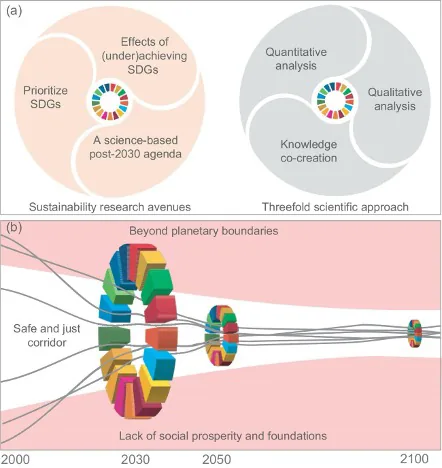
First, quantitative research is essential for identifying patterns, interactions and gaps across the SDGs. Drawing on multiple data sources, such as unified SDG databases, allows researchers to assess progress more systematically. However, Dr Pradhan noted that existing integrated assessment models still have limited coverage of social dimensions such as equity and justice.
Second, qualitative research is needed to understand why these interactions occur. Methods such as systematic literature reviews, expert elicitation and case studies help uncover underlying mechanisms, particularly where data are scarce, and translate quantitative findings into policy-relevant insights.
Third, knowledge co-creation with stakeholders is critical. Engaging with practitioners, communities and policymakers supports the localisation of the SDGs, strengthens ownership of solutions and ensures that equity, justice and the needs of vulnerable and Indigenous groups are better reflected in implementation.
Building on this framework, Dr Pradhan identified three priority research avenues: prioritising SDGs to maximise synergies and manage trade-offs; assessing whether achieving SDG targets genuinely delivers sustainability; and urgently preparing a more science-based post-2030 agenda that addresses known limitations of the current framework.
He illustrated these challenges using examples from alternative food movements such as urban farming. While such initiatives can contribute to zero hunger, they may also reproduce inequalities, pose health risks or intensify resource use — highlighting the need for integrated assessment rather than single-goal solutions.
Dr Pradhan concluded with a call to action summarised by the acronym RAIN: Reinforce partnerships, Act and implement now, Integrated impact assessment, and recognition of the differentiated needs of people to safeguard humanity’s future.
NRI’s Dr Laxmi Pant, who organised the seminar, said: ‘This seminar highlighted why integrated, evidence-based approaches are essential if the SDGs are to deliver real change. As we approach 2030, the need to rethink how science informs policy has never been more urgent.’
With only five years remaining until 2030, the seminar underscored both the scale of the challenge and the opportunity to reset trajectories, informing not only accelerated SDG action but also the foundations of what comes next.