
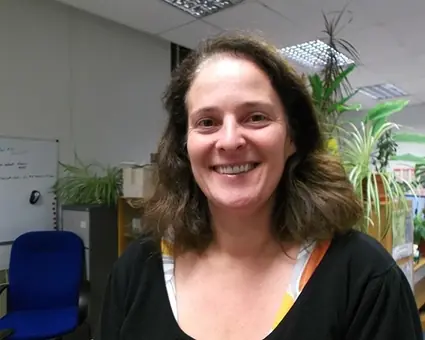
Professor Valerie Nelson
BA Hons., MSc, PhD
Professor of Sustainability and Political Ecology
Livelihoods and Institutions Department
+44 (0)1634 88 3156


Valerie Nelson is Professor of Sustainability and Political Ecology and leads the Centre for Society, Environment and Development. Her work is grounded in decolonial, relational and more‑than‑human approaches to sustainability, challenging extractivist, technocratic and growth‑centric paradigms. She works with political ecology as a practice of critique and care, centring questions of power, justice, land, responsibility and the conditions for collective flourishing across human and more‑than‑human worlds.
She holds a first degree in Social Anthropology (University of Cambridge), an MSc in Rural Resources and Environmental Policy (Wye College, University of London), and a PhD entitled Global Supply Chain Sustainability Initiatives: Impacts, Governance, Systemic Constraints and Regenerative Alternatives (University of Greenwich). She currently co‑leads the Political Ecology, Culture and Arts Research Group at NRI. The group’s work is explicitly committed to pluriversal futures and explores relationality and the more‑than‑human; Indigenous and local ontologies; socionatures and biodiversity; land, territory and ecojustice; the politics and meanings of food and farming; transformative change and social movements; post‑growth economies, commoning and repair; environmental intersectionalities; and ethics of care that exceed the human.
Valerie’s research has long worked with participatory methods, developing participatory, creative methods such as participatory video and farmer-to-farmer learning in the 1990s and has continued with a series of farmer, community-based and multi-actor social learning processes. She increasingly engages arts‑based methods and collaborations as decolonial practices of inquiry to explore justice and futures. These approaches aim to unsettle dominant narratives, open space for marginalised and Indigenous ways of knowing, and support collective imagination of otherwise worlds. Current research centres upon more-than-human and relational approaches, and trans-hegemonic approaches to transformative change.
She has worked in international development and environmental research since 1992. Her early work in Belize focused on community engagement in forest planning and management, undertaking long‑term, situated research with Mayan and migrant communities. This was followed by research at an agricultural research institute of the University of the State of Mexico, working with Mazahua Indigenous Peoples in the central highlands to understand agrarian lifeways, territorial relations and knowledge systems embedded in land and practice.
Following a period supporting transnational partnerships between protected areas in Europe, Latin America and Asia, she joined Oxfam GB’s Policy Department, contributing to the South–South Environment Learning Programme. Since joining NRI in 1996, Valerie has developed a sustained body of critical, interpretive, participatory and transdisciplinary research spanning food politics and governance, agroecology, land rights, climate change adaptation, rural development, and latterly biodiversity, human-nature relations and sustainability transformations. Her work brings together political ecology, critical geography, anthropology and Indigenous‑informed epistemologies, and is grounded in collaboration with diverse social and other-than human communities and social movements in Latin America, Sub‑Saharan Africa, Asia and the UK.
She has led major research and action‑learning programmes (EU Horizon, FCDO, ESRC funded), including on diverse topics including: participatory rural development; socio‑ecological approaches to livelihoods and food systems; gendered and intersectional climate adaptation; smallholder agricultural resilience; land rights and territorial governance; agroecology and alternative food networks; and critical analyses of fair trade, sustainability standards and global value chains. She has explored post‑growth, regenerative and commons‑based economies, and transformative change from Indigenous, feminist and more‑than‑human perspectives.
Valerie is an expert contributor to the Intergovernmental Science–Policy Platform on Biodiversity and Ecosystem Services (IPBES). She was a contributing author to the Values Assessment (2022), a Scoping expert in the Business and Biodiversity Scoping Study (2022) and was a Lead Author for the Transformative Change Assessment (2024), in which she addressed colonial modernity, relational, More-than-Human and Indigenous ontologies. She actively supports IPBES Indigenous and Local Knowledge dialogues. She was a Lead Author for the UNEP Global Environment Outlook GEO‑7 State of the Environment Report (2025) and served on the GEO‑7 Indigenous and Local Knowledge Taskforce. She is a Coordinating Lead Author for the Options for Action chapter of the ongoing IPBES Second Global Biodiversity Assessment.
Her policy‑engaged work includes serving on the Scottish Government’s Environment Strategy Advisory Panel on international impacts (2023) and leading research on transformative change which has informed the first ever Strategy (2026). She is a member of Natural England’s Nature Futures Advisory Group and is engaging with Natural England and other nature agencies on transformative change. She is also part of the Friends of the International Land Coalition, aligning with global struggles for land justice and Indigenous territorial rights. Previously, she served for six years on the UK and Ireland Development Studies Association Council, co‑leading the Climate and Development Study Group and convening critical political ecology panels. Valerie is also an experienced evaluation and learning specialist, leading complex, multi‑country evaluations grounded in reflexivity, participation and power awareness. She has undertaken high‑level consultancies for organisations including the International Land Coalition, UNDP, the European Commission, Irish Aid, FCDO, the Dutch Government, ISEAL, ILO, Defra, BEIS, CGIAR, Oxfam, Fairtrade International, the Fairtrade Foundation, Rainforest Alliance and others.
She is a Section Editor for PLOS: Sustainability and Transformation and a co‑editor of Global Social Challenges.
Valerie has contributed to the establishment of new research fields, most notably gender and climate change beginning in the early 1990s and subsequently, and the impact, governance and power relations in agro-food systems, including critical analysis of hybrid governance and its limitations and governmentality, such as reform-oriented approaches (e.g. corporate codes, sustainability standards, due diligence, sector transformation). She has explored alternative food networks and agroecology movements and practices and developed new participatory, action research and transdisciplinary methodologies, e.g. pioneering participatory video in Malawi (1996-98), farmer and stakeholder climate future learning journeys in Tanzania (2010s), farmer field school evaluation in Malawi and transdisciplinary multi-stakeholder and civic engagement in learning cycles.
Valerie currently leads the Political Ecology, Culture and Arts (PEAC) Research Group at the NRI (ADD URL), which has the following research themes:
- Relationality and sustainability
- The more-than-human, socionatures and biodiversity
- Politics and meanings of food and farming
- Ecojustice, power and land
- Transformative change, social movements and sustainability futures.
- Post-growth economies and communing.
- Environmental intersectionalities and ethics of care.
Her current work focuses upon the following: relational philosophies and sustainability; critical analysis and action research on imaginaries, socionatures and human-nature relations; colonial modernities, pluriversal conviviality and transformative change; biodiversity and equity in telecoupled agrofood system contexts; Indigenous land rights and futures; arts-based methods and speculative futuring.
Transformative Change in telecoupled agrofood systems for biodiversity and equity (EU Horizon, 2023-26)
Partnering with Wageningen University, Netherlands, University of the Andes, Colombia, University of Dschang, Cameroon, the University of Kabianga, Kenya, IDDRI and CIRAD, France, and Hanken University, Finland. The project explores transformative pathways in agro-food systems, moving beyond reform-oriented market-based mechanisms to explore more radical regenerative alternatives. Includes research on rural imaginaries, the more-than-human, emotional ecologies, and issues of biodiversity, equity and justice, within landscapes linked to EU consumption and biodiversity, analysis of transformative change pathways, leverage points and levers e.g. rights of nature, social movements, collective action and commoning for transformative change, as well as facilitating social learning cycles at landscape, national, EU and global scales.
Food and Nature Futures in Medway (2023-24).
Funded by the Regional Innovation Fund, exploring food and nature futures in Medway, Kent, though innovative arts-based approaches, social learning processes and surveys
Social learning for people-centred land governance
Social learning for LandCollaborative, a Global Community of Practice involving social learning cycles and co-production of learning outputs for the LandCollaborative (International Land Coalition, Mekong Delta Rural Land Governance Programme and WeltHunger Hilfe (WHH) LandforLife programme). The project involved working with 27 organisations in 13 national civil society platforms working on land rights and governance.
Critical analysis and assessment of fair trade and sustainability market-based mechanisms and responsible business approaches.
Multiple studies on fair and ethical trade schemes, sustainability standards and certification impacts, social impacts of corporate codes of practice, sector transformation and sustainable landscape approaches, responsible business and ethical trade schemes, trade and global value chains social and economic upgrading innovations, and sustainable finance for diverse donors and research councils (FCDO, ILO, Fairtrade International, Fairtrade Foundation, Max Havelaar, ISEAL, Better Cotton Initiative, Rainforest Alliance, Dutch government). This work led the way asking questions about the effectiveness, impact, politics and governance of private standards and alternative, solidarity trade schemes and initiatives. It generated extensive evidence on impacts, research on the politics and ethics of value chain sustainability governance, and highlighted the inherent limitations and problems associated with market-based mechanisms for sustainability and transformative change. Recent studies on human rights, environmental due diligence and rights of nature.
Politics and governance implications of private standards initiatives in Kenyan agri-food chains (2008-2011)
With the Universities of Leeds and Nairobi (ESRC-DFID). This research explored actor struggles over value chain sustainability governance and the emerging role of private actors in shaping narratives and practices. Looking beyond the vertical, the research explored the embedded nature of global value chains and the power inequalities infused in such agrofood chains, the contingent nature of smallholder and worker agency and participation, and the governmentality of sustainability standards and codes. The control-oriented nature of ethical governance was identified as well as areas of resistance and alternative economy narratives.
Transdisciplinarity and participatory learning approaches in sustainable agriculture and agroecology
Over several decades including pioneering work on participatory video to support community enquiry, communication and advocacy on livelihoods and the environment in Malawi (1996-98, DFID funded), Farms of the Future project involving facilitation of farmer and agriculture stakeholder learning journeys on climate adaptation in Ghana, Burkina Faso and Tanzania (CCAFS, 2011-13), National Learning Alliances using multi-stakeholder social learning cycles on sustainable agriculture in Tanzania, Malawi, Zambia, Ghana and Ethiopia (DFID SAIRLA programme), and participatory farming learning including video documentation in evaluative learning on FAO Strengthening Climate Resilience Programme (EC Global Climate Change Alliance, Malawi, 2015-19). Recent study for Agrinatura on Agroecology and Value Chains with FIBL.
- Lachlan Kenneally: PhD on ‘Relational and political ecology perspectives on urban food and commoning in Bristol’.
- Riley Hickman: PhD on ‘Soil(ed) Relations: Synergies and Struggles in Soil Relations and Politics’ in collaboration with Simon Wilcox, Rothamstead.
- Niall Readfern: PhD on ‘Niall Readfern, PhD on Power and Perspective: Investigating interactions between telecoupled agrofood systems and plural landscape meanings in biodiversity rich forest landscapes in Kenya.’
Valerie is currently teaching on the NRI Masters on Sustainable Development, leading a module on Regenerative economies, politics and societies. She is supervising several PhD students on subjects involving relational and political ecology themes, including astro-scholarship, rights of nature, More-Than-Human relations and deer, soil relationality and care ethics, and tropical futurism and imaginaries in commodity frontiers.
- Leader of the Political Ecology, Culture and Arts Research Group.
- Defra Nature Futures Framework Advisory Group (23-24). Valerie Nelson.
- United Nations Environment Programme (UNEP) GEO 7 Lead Author (2023 – 26), Chapter on Impacts, focusing on Sustainable Development Goals, Representative in the Indigenous and Local Knowledge Taskforce. Valerie Nelson
- Global advisory group of the International Land Coalition. NRI co-representative in ILC global advisory group, (2021 – ongoing). Valerie Nelson.
- IPBES ‘Transformative Change Assessment of Inter-Governmental Science Policy Platform on Biodiversity and Ecosystem Services’ (IPBES) (2022-24). Lead author in Chapter 4. ILK dialogue author representative. Valerie Nelson.
- Inter-Governmental Science Policy Platform on Biodiversity and Ecosystem Services – Scoping Study on Business and Biodiversity. ILK dialogue author representative. Valerie Nelson
- IPBES ‘Methodological Assessment on incorporating multiple values of nature and nature’s contributions to people for just and sustainable futures.’ Chapter 5. Inter-Governmental Science Policy Platform on Biodiversity and Ecosystem Services – Contributing Author. Valerie Nelson
- Council Member, UK and Ireland Development Studies Association (6 years)
- Global Award (IDEAS) Transformative Change Evaluation
- Co-track chair International Sustainable Development Research Society (ISDRS) on value chains and sustainability.
- Harmáčková, Z. V., Yoshida, Y., Sitas, N., Manetti, L., Martin, A., Kumar, R., Berbes, M., Collins, R., Eisenack, K., Guimaraes, E., Heras, M., Nelson, V., Niamir, A., Ravera, F., Ruiz Mallen, I. & O’Farrell, P. (accepted) ‘What types of values underlie sustainable and just futures?’ Current Opinion in Environmental Sustainability (COSUST).
- Martin-Ortega O, Dehbi F, Nelson V, Pillay R. Towards a Business, Human Rights and the Environment Framework. Sustainability. 2022; 14(11):6596. https://doi.org/10.3390/su14116596
- Lamboll, R., V. Nelson et al (2021) Strengthening decision-making on Sustainable Agricultural Intensification through Multi-Stakeholder Social Learning in sub-Saharan Africa. Int J Agricultural Sustainability 19:5-6, 609-635.
- Nelson, Valerie J., Rueda, Ximena and Vermeulen, Walter J.V. (2018) Challenges and opportunities for the sustainability transition in global trade (Introduction). Business Strategy and the Environment, 27 (2). pp. 173-178. ISSN 0964-4733 (Print), 1099-0836 (Online) (doi:10.1002/bse.2008)
- Nelson, Valerie and Phillips, David (2018) Sector, landscape or rural transformations? Exploring the limits and potential of agricultural sustainability initiatives through a cocoa case study. Business Strategy and the Environment, 27 (2). pp. 252-262. ISSN 0964-4733 (Print), 1099-0836 (Online) (doi:10.1002/bse.2014)
- Lamboll, Richard, Nelson, Valerie, Posthumus, Helena, Martin, Adrienne ORCID: 0000-0001-9305-7302, Adebayo, Kolawole, Alacho, Francis, Dziedzoave, Nanam, Mahende, Grace, Sandifolo, Vito, Sanni, Lateef, Abayomi, Louise, Graffham, Andrew, Hillocks, Rory and Westby, Andrew (2015) Practical lessons on scaling up smallholder-inclusive and sustainable cassava value chains in Africa. Food Chain, 5 (1-2). pp. 28-52. ISSN 2046-1879 (Print), 2046-1887 (Online) (doi:10.3362/2046-1887.2015.004)
- Nelson, Valerie and Tallontire, Anne (2014) Battlefields of ideas: changing narratives and power dynamics in private standards in global agricultural value chains. Agriculture and Human Values, 31 (3). pp. 481-497. ISSN 0889-048X (Print), 1572-8366 (Online) (doi:10.1007/s10460-014-9512-8)
- Nelson, Valerie and Martin, Adrienne ORCID: 0000-0001-9305-7302 (2014) Exploring issues of rigour and utility in Fairtrade impact assessment. Food Chain, 4 (1). pp. 14-33. ISSN 2046-1879 (Print), 2046-1887 (Online) (doi:10.3362/2046-1887.2014.003)
- Tallontire, Anne, Opondo, Maggie and Nelson, Valerie (2013) Contingent spaces for smallholder participation in GlobalGAP: insights from Kenyan horticulture value chains. The Geographical Journal, 180 (4). pp. 353-364. ISSN 0016-7398 (Print), 1475-4959 (Online) (doi:10.1111/geoj.12047)
- Tallontire, Anne and Nelson, Valerie (2013) Fair trade narratives and political dynamics. Social Enterprise Journal, 9 (1). pp. 28-52. ISSN 1750-8614 (doi:10.1108/17508611311329994)
- Nelson, Valerie and Martin, Adrienne ORCID: 0000-0001-9305-7302 (2012) The impact of Fairtrade: Evidence, shaping factors, and future pathways. Food Chain, 2 (1). pp. 42-63. ISSN 2046-1879 (Print), 2046-1887 (Online) (doi:10.3362/2046-1887.2012.005)
- Boyd, Emily, Grist, Natasha, Juhola, Sirkku and Nelson, Valerie (2009) Exploring development futures in a changing climate: frontiers for development policy and practice. Development Policy Review, 27 (6). pp. 659-674. ISSN 0950-6764 (Print), 1467-7679 (Online) (doi:10.1111/j.1467-7679.2009.00464.x)
- Tallontire, Anne, Opondo, Maggie, Nelson, Valerie and Martin, Adrienne ORCID: 0000-0001-9305-7302 (2009) Beyond the vertical? Using value chains and governance as a framework to analyse private standards initiatives in agri-food chains. Agriculture and Human Values, 28 (3). pp. 427-441. ISSN 0889-048X (Print), 1572-8366 (Online) (doi:10.1007/s10460-009-9237-2)
- Nelson, Valerie and Stathers, Tanya ORCID: 0000-0002-7767-6186 (2009) Resilience, power, culture, and climate: A case study from semi-arid Tanzania, and new research directions. Gender & Development, 17 (1). pp. 81-94. ISSN 1355-2074 (Print), 1364-9221 (Online) (doi:10.1080/13552070802696946)
- Nelson, Valerie, Martin, Adrienne ORCID: 0000-0001-9305-7302 and Ewert, Joachim (2007) The impacts of codes of practice on worker livelihoods: empirical evidence from the South African wine and Kenyan cut flower industries. Journal of Corporate Citizenship (28). pp. 61-72. ISSN 1470-5001
Book Section
- Nelson, Valerie and Martin, Adrienne ORCID: 0000-0001-9305-7302 (2015) Fairtrade international’s multi-dimensional impacts in Africa. In: Raynolds, Laura T and Bennett, Elizabeth A., (eds.) Handbook of Research on Fair Trade. Edward Elgar Publishing, Cheltenham, UK, pp. 509-531. ISBN 9781783474608 (doi:10.4337/9781783474622.00040)
- Nelson, Valerie, Tallontire, Anne, Opondo, Maggie and Martin, Adrienne ORCID: 0000-0001-9305-7302 (2014) Pathways of transformation or transgression? Power relations, ethical space and labour rights in Kenyan cut flower value chains. In: Goodman, Michael K. and Sage, Colin, (eds.) Food transgressions: Making sense of contemporary food politics. Routledge, pp. 15-38. ISBN 978-0754679707
- Blowfield, Michael, Gallat, Stephanie, Malins, Annabelle, Maynard, Bill, Nelson, Valerie and Robinson, Dawn (1999) Ethical trade and sustainable rural livelihoods. Natural Resources Institute, Chatham, UK. ISBN 0-85954-503-2
Edited Book
- Nelson, Valerie (ed.) (2017) Fairtrade Impacts: Lessons from around the world. Fairtrade Impacts. Practical Action Publishing, Hampshire, UK. ISBN 978-1853399077 (doi:10.3362/9781780449067)
Working Paper
- Nelson, Valerie, Morton, John, Apenteng, Essie Aduwa Ape and Lamboll, Richard (2013) African Agricultural Research and Advisory Services under Climate Change: Perspectives from an E-Discussion. [Working Paper]
- Tallontire, Anne, Nelson, Valerie, Dixon, Jami and Benton, Tim G. (2012) A review of the literature and knowledge of standards and certification systems in agricultural production and farming systems (NRI working paper series on sustainability standards No. 2). [Working Paper]
- Nelson, Valerie (2000) Zambia feeder roads research project rural transport policy toolkit: Livelihoods profile for North and Luapula provinces. [Working Paper]
Monograph
- Nelson, V., Haggar, J., Martin, A. ORCID: 0000-0001-9305-7302, Donovan, J., Borasino, E., Hasyim, W., Mhando, N., Senga, M., Mgumia, J., Quitanar-Guadarrama, E., Kendar, Z., Valdez, J. and Morales, D. (2016) Fairtrade Coffee A study to assess the impact of Fairtrade for coffee smallholders and producer organisations in Indonesia, Mexico, Peru, and Tanzania. Technical Report. University of Greenwich, Chatham, UK.
- Nelson, Valerie, Martin, Adrienne ORCID: 0000-0001-9305-7302, Ewert, Joachim, Hasan, Abu Ala, Opondo, Maggie, Flint, Michael, Hartog, Maaike and Priebe, Jan (2016) Trade and Global Value Chains Initiative: Mid-Term Evaluation Report. Technical Report. University of Greenwich, Chatham, UK.
- Morton, J., Kisauzi, D., Ohiomoba, I., Demby, D., Mangheni, M., Moumouni, I., Parkinson, V., Suale, D., Lamboll, R., Nelson, V. and Quan, J. (2014) Climate, agriculture and knowledge in Africa: Agricultural research and advisory services in the face of climate change. Final synthesis report of the climate learning for African agriculture project. Project Report. University of Greenwich (NRI), FARA and AFAAS, Chatham, UK.
- Nelson, Valerie, Smith, Sally, Martin, Adrienne ORCID: 0000-0001-9305-7302 and Vanhuyse, Fedra (2012) Comic Relief trade Programme Evaluation. Technical Report. Natural Resources Institute, University of Greenwich, Chatham, UK.
- Martin, Adrienne ORCID: 0000-0001-9305-7302 and Nelson, Valerie (2012) Impact assessment policies and practices of EIARD members: study. Technical Report. AGRINATURA-EEIG Secretariat, Paris, France.
- Nelson, Valerie, Morton, John F., Chancellor, Tim ORCID: 0000-0002-4442-7001, Burt, Peter and Pound, Barry (2010) Climate change, agriculture and Fairtrade: identifying the challenges and opportunities. Working Paper. Natural Resources Institute, Natural Resources Institute [website] / Fairtrade Foundation [website].
- Nelson, Valerie, Galvez, Modesto and Blowfield, Mick (2000) Social impact of ethical and conventional brazil nut trading on forest-dependent people in Peru. Technical Report. Natural Resources Institute, Chatham, UK.
Other
- Kumar, R. ORCID: 0000-0002-0157-1310, Nelson, V., Martin, A. ORCID: 0000-0001-9305-7302, Badal, D., Latheef, A., Suresh Reddy, B., Narayanan, L., Young, S. and Hartog, M. (2016) Evaluation of the early impacts of the better cotton initiative on smallholder cotton producers in Kurnool District, India: Baseline report. ISEAL Alliance, London.
- Nelson, Valerie, Morton, John, Forsythe, Lora ORCID: 0000-0001-9931-4453, Martin, Adrienne ORCID: 0000-0001-9305-7302 and Hartog, Maaike (2015) Achieving dryland women's empowerment: environmental resilience and social transformation. UNCCD, UNDP, Greenwich.
- Forsythe, Lora ORCID: 0000-0001-9931-4453, Morton, John, Nelson, Valerie, Martin, Adrienne ORCID: 0000-0001-9305-7302 and Hartog, Maaike (2015) Gender and drylands governance: Empowering women for change. UNDP, UNCCD, Greenwich.
- Forsythe, Lora ORCID: 0000-0001-9931-4453, Morton, John, Nelson, Valerie, Quan, Julian, Martin, Adrienne ORCID: 0000-0001-9305-7302 and Hartog, Maaike (2015) Strengthening dryland women's land rights: local contexts, global change. UNCCD, UNDP, Greenwich.
- Nelson, Valerie, Forsythe, Lora ORCID: 0000-0001-9931-4453 and Morton, John (2015) Synthesis of thematic papers from the series ‘Women’s empowerment in the drylands. UNCCD and UNDP, Greenwich.
Valerie Nelson is Professor of Sustainability and Political Ecology and leads the Centre for Society, Environment and Development. Her work is grounded in decolonial, relational and more‑than‑human approaches to sustainability, challenging extractivist, technocratic and growth‑centric paradigms. She works with political ecology as a practice of critique and care, centring questions of power, justice, land, responsibility and the conditions for collective flourishing across human and more‑than‑human worlds.
She holds a first degree in Social Anthropology (University of Cambridge), an MSc in Rural Resources and Environmental Policy (Wye College, University of London), and a PhD entitled Global Supply Chain Sustainability Initiatives: Impacts, Governance, Systemic Constraints and Regenerative Alternatives (University of Greenwich). She currently co‑leads the Political Ecology, Culture and Arts Research Group at NRI. The group’s work is explicitly committed to pluriversal futures and explores relationality and the more‑than‑human; Indigenous and local ontologies; socionatures and biodiversity; land, territory and ecojustice; the politics and meanings of food and farming; transformative change and social movements; post‑growth economies, commoning and repair; environmental intersectionalities; and ethics of care that exceed the human.
Valerie’s research has long worked with participatory methods, developing participatory, creative methods such as participatory video and farmer-to-farmer learning in the 1990s and has continued with a series of farmer, community-based and multi-actor social learning processes. She increasingly engages arts‑based methods and collaborations as decolonial practices of inquiry to explore justice and futures. These approaches aim to unsettle dominant narratives, open space for marginalised and Indigenous ways of knowing, and support collective imagination of otherwise worlds. Current research centres upon more-than-human and relational approaches, and trans-hegemonic approaches to transformative change.
She has worked in international development and environmental research since 1992. Her early work in Belize focused on community engagement in forest planning and management, undertaking long‑term, situated research with Mayan and migrant communities. This was followed by research at an agricultural research institute of the University of the State of Mexico, working with Mazahua Indigenous Peoples in the central highlands to understand agrarian lifeways, territorial relations and knowledge systems embedded in land and practice.
Following a period supporting transnational partnerships between protected areas in Europe, Latin America and Asia, she joined Oxfam GB’s Policy Department, contributing to the South–South Environment Learning Programme. Since joining NRI in 1996, Valerie has developed a sustained body of critical, interpretive, participatory and transdisciplinary research spanning food politics and governance, agroecology, land rights, climate change adaptation, rural development, and latterly biodiversity, human-nature relations and sustainability transformations. Her work brings together political ecology, critical geography, anthropology and Indigenous‑informed epistemologies, and is grounded in collaboration with diverse social and other-than human communities and social movements in Latin America, Sub‑Saharan Africa, Asia and the UK.
She has led major research and action‑learning programmes (EU Horizon, FCDO, ESRC funded), including on diverse topics including: participatory rural development; socio‑ecological approaches to livelihoods and food systems; gendered and intersectional climate adaptation; smallholder agricultural resilience; land rights and territorial governance; agroecology and alternative food networks; and critical analyses of fair trade, sustainability standards and global value chains. She has explored post‑growth, regenerative and commons‑based economies, and transformative change from Indigenous, feminist and more‑than‑human perspectives.
Valerie is an expert contributor to the Intergovernmental Science–Policy Platform on Biodiversity and Ecosystem Services (IPBES). She was a contributing author to the Values Assessment (2022), a Scoping expert in the Business and Biodiversity Scoping Study (2022) and was a Lead Author for the Transformative Change Assessment (2024), in which she addressed colonial modernity, relational, More-than-Human and Indigenous ontologies. She actively supports IPBES Indigenous and Local Knowledge dialogues. She was a Lead Author for the UNEP Global Environment Outlook GEO‑7 State of the Environment Report (2025) and served on the GEO‑7 Indigenous and Local Knowledge Taskforce. She is a Coordinating Lead Author for the Options for Action chapter of the ongoing IPBES Second Global Biodiversity Assessment.
Her policy‑engaged work includes serving on the Scottish Government’s Environment Strategy Advisory Panel on international impacts (2023) and leading research on transformative change which has informed the first ever Strategy (2026). She is a member of Natural England’s Nature Futures Advisory Group and is engaging with Natural England and other nature agencies on transformative change. She is also part of the Friends of the International Land Coalition, aligning with global struggles for land justice and Indigenous territorial rights. Previously, she served for six years on the UK and Ireland Development Studies Association Council, co‑leading the Climate and Development Study Group and convening critical political ecology panels. Valerie is also an experienced evaluation and learning specialist, leading complex, multi‑country evaluations grounded in reflexivity, participation and power awareness. She has undertaken high‑level consultancies for organisations including the International Land Coalition, UNDP, the European Commission, Irish Aid, FCDO, the Dutch Government, ISEAL, ILO, Defra, BEIS, CGIAR, Oxfam, Fairtrade International, the Fairtrade Foundation, Rainforest Alliance and others.
She is a Section Editor for PLOS: Sustainability and Transformation and a co‑editor of Global Social Challenges.
Valerie has contributed to the establishment of new research fields, most notably gender and climate change beginning in the early 1990s and subsequently, and the impact, governance and power relations in agro-food systems, including critical analysis of hybrid governance and its limitations and governmentality, such as reform-oriented approaches (e.g. corporate codes, sustainability standards, due diligence, sector transformation). She has explored alternative food networks and agroecology movements and practices and developed new participatory, action research and transdisciplinary methodologies, e.g. pioneering participatory video in Malawi (1996-98), farmer and stakeholder climate future learning journeys in Tanzania (2010s), farmer field school evaluation in Malawi and transdisciplinary multi-stakeholder and civic engagement in learning cycles.
Valerie currently leads the Political Ecology, Culture and Arts (PEAC) Research Group at the NRI (ADD URL), which has the following research themes:
- Relationality and sustainability
- The more-than-human, socionatures and biodiversity
- Politics and meanings of food and farming
- Ecojustice, power and land
- Transformative change, social movements and sustainability futures.
- Post-growth economies and communing.
- Environmental intersectionalities and ethics of care.
Her current work focuses upon the following: relational philosophies and sustainability; critical analysis and action research on imaginaries, socionatures and human-nature relations; colonial modernities, pluriversal conviviality and transformative change; biodiversity and equity in telecoupled agrofood system contexts; Indigenous land rights and futures; arts-based methods and speculative futuring.
Transformative Change in telecoupled agrofood systems for biodiversity and equity (EU Horizon, 2023-26)
Partnering with Wageningen University, Netherlands, University of the Andes, Colombia, University of Dschang, Cameroon, the University of Kabianga, Kenya, IDDRI and CIRAD, France, and Hanken University, Finland. The project explores transformative pathways in agro-food systems, moving beyond reform-oriented market-based mechanisms to explore more radical regenerative alternatives. Includes research on rural imaginaries, the more-than-human, emotional ecologies, and issues of biodiversity, equity and justice, within landscapes linked to EU consumption and biodiversity, analysis of transformative change pathways, leverage points and levers e.g. rights of nature, social movements, collective action and commoning for transformative change, as well as facilitating social learning cycles at landscape, national, EU and global scales.
Food and Nature Futures in Medway (2023-24).
Funded by the Regional Innovation Fund, exploring food and nature futures in Medway, Kent, though innovative arts-based approaches, social learning processes and surveys
Social learning for people-centred land governance
Social learning for LandCollaborative, a Global Community of Practice involving social learning cycles and co-production of learning outputs for the LandCollaborative (International Land Coalition, Mekong Delta Rural Land Governance Programme and WeltHunger Hilfe (WHH) LandforLife programme). The project involved working with 27 organisations in 13 national civil society platforms working on land rights and governance.
Critical analysis and assessment of fair trade and sustainability market-based mechanisms and responsible business approaches.
Multiple studies on fair and ethical trade schemes, sustainability standards and certification impacts, social impacts of corporate codes of practice, sector transformation and sustainable landscape approaches, responsible business and ethical trade schemes, trade and global value chains social and economic upgrading innovations, and sustainable finance for diverse donors and research councils (FCDO, ILO, Fairtrade International, Fairtrade Foundation, Max Havelaar, ISEAL, Better Cotton Initiative, Rainforest Alliance, Dutch government). This work led the way asking questions about the effectiveness, impact, politics and governance of private standards and alternative, solidarity trade schemes and initiatives. It generated extensive evidence on impacts, research on the politics and ethics of value chain sustainability governance, and highlighted the inherent limitations and problems associated with market-based mechanisms for sustainability and transformative change. Recent studies on human rights, environmental due diligence and rights of nature.
Politics and governance implications of private standards initiatives in Kenyan agri-food chains (2008-2011)
With the Universities of Leeds and Nairobi (ESRC-DFID). This research explored actor struggles over value chain sustainability governance and the emerging role of private actors in shaping narratives and practices. Looking beyond the vertical, the research explored the embedded nature of global value chains and the power inequalities infused in such agrofood chains, the contingent nature of smallholder and worker agency and participation, and the governmentality of sustainability standards and codes. The control-oriented nature of ethical governance was identified as well as areas of resistance and alternative economy narratives.
Transdisciplinarity and participatory learning approaches in sustainable agriculture and agroecology
Over several decades including pioneering work on participatory video to support community enquiry, communication and advocacy on livelihoods and the environment in Malawi (1996-98, DFID funded), Farms of the Future project involving facilitation of farmer and agriculture stakeholder learning journeys on climate adaptation in Ghana, Burkina Faso and Tanzania (CCAFS, 2011-13), National Learning Alliances using multi-stakeholder social learning cycles on sustainable agriculture in Tanzania, Malawi, Zambia, Ghana and Ethiopia (DFID SAIRLA programme), and participatory farming learning including video documentation in evaluative learning on FAO Strengthening Climate Resilience Programme (EC Global Climate Change Alliance, Malawi, 2015-19). Recent study for Agrinatura on Agroecology and Value Chains with FIBL.
- Lachlan Kenneally: PhD on ‘Relational and political ecology perspectives on urban food and commoning in Bristol’.
- Riley Hickman: PhD on ‘Soil(ed) Relations: Synergies and Struggles in Soil Relations and Politics’ in collaboration with Simon Wilcox, Rothamstead.
- Niall Readfern: PhD on ‘Niall Readfern, PhD on Power and Perspective: Investigating interactions between telecoupled agrofood systems and plural landscape meanings in biodiversity rich forest landscapes in Kenya.’
Valerie is currently teaching on the NRI Masters on Sustainable Development, leading a module on Regenerative economies, politics and societies. She is supervising several PhD students on subjects involving relational and political ecology themes, including astro-scholarship, rights of nature, More-Than-Human relations and deer, soil relationality and care ethics, and tropical futurism and imaginaries in commodity frontiers.
- Leader of the Political Ecology, Culture and Arts Research Group.
- Defra Nature Futures Framework Advisory Group (23-24). Valerie Nelson.
- United Nations Environment Programme (UNEP) GEO 7 Lead Author (2023 – 26), Chapter on Impacts, focusing on Sustainable Development Goals, Representative in the Indigenous and Local Knowledge Taskforce. Valerie Nelson
- Global advisory group of the International Land Coalition. NRI co-representative in ILC global advisory group, (2021 – ongoing). Valerie Nelson.
- IPBES ‘Transformative Change Assessment of Inter-Governmental Science Policy Platform on Biodiversity and Ecosystem Services’ (IPBES) (2022-24). Lead author in Chapter 4. ILK dialogue author representative. Valerie Nelson.
- Inter-Governmental Science Policy Platform on Biodiversity and Ecosystem Services – Scoping Study on Business and Biodiversity. ILK dialogue author representative. Valerie Nelson
- IPBES ‘Methodological Assessment on incorporating multiple values of nature and nature’s contributions to people for just and sustainable futures.’ Chapter 5. Inter-Governmental Science Policy Platform on Biodiversity and Ecosystem Services – Contributing Author. Valerie Nelson
- Council Member, UK and Ireland Development Studies Association (6 years)
- Global Award (IDEAS) Transformative Change Evaluation
- Co-track chair International Sustainable Development Research Society (ISDRS) on value chains and sustainability.
- Harmáčková, Z. V., Yoshida, Y., Sitas, N., Manetti, L., Martin, A., Kumar, R., Berbes, M., Collins, R., Eisenack, K., Guimaraes, E., Heras, M., Nelson, V., Niamir, A., Ravera, F., Ruiz Mallen, I. & O’Farrell, P. (accepted) ‘What types of values underlie sustainable and just futures?’ Current Opinion in Environmental Sustainability (COSUST).
- Martin-Ortega O, Dehbi F, Nelson V, Pillay R. Towards a Business, Human Rights and the Environment Framework. Sustainability. 2022; 14(11):6596. https://doi.org/10.3390/su14116596
- Lamboll, R., V. Nelson et al (2021) Strengthening decision-making on Sustainable Agricultural Intensification through Multi-Stakeholder Social Learning in sub-Saharan Africa. Int J Agricultural Sustainability 19:5-6, 609-635.
- Nelson, Valerie J., Rueda, Ximena and Vermeulen, Walter J.V. (2018) Challenges and opportunities for the sustainability transition in global trade (Introduction). Business Strategy and the Environment, 27 (2). pp. 173-178. ISSN 0964-4733 (Print), 1099-0836 (Online) (doi:10.1002/bse.2008)
- Nelson, Valerie and Phillips, David (2018) Sector, landscape or rural transformations? Exploring the limits and potential of agricultural sustainability initiatives through a cocoa case study. Business Strategy and the Environment, 27 (2). pp. 252-262. ISSN 0964-4733 (Print), 1099-0836 (Online) (doi:10.1002/bse.2014)
- Lamboll, Richard, Nelson, Valerie, Posthumus, Helena, Martin, Adrienne ORCID: 0000-0001-9305-7302, Adebayo, Kolawole, Alacho, Francis, Dziedzoave, Nanam, Mahende, Grace, Sandifolo, Vito, Sanni, Lateef, Abayomi, Louise, Graffham, Andrew, Hillocks, Rory and Westby, Andrew (2015) Practical lessons on scaling up smallholder-inclusive and sustainable cassava value chains in Africa. Food Chain, 5 (1-2). pp. 28-52. ISSN 2046-1879 (Print), 2046-1887 (Online) (doi:10.3362/2046-1887.2015.004)
- Nelson, Valerie and Tallontire, Anne (2014) Battlefields of ideas: changing narratives and power dynamics in private standards in global agricultural value chains. Agriculture and Human Values, 31 (3). pp. 481-497. ISSN 0889-048X (Print), 1572-8366 (Online) (doi:10.1007/s10460-014-9512-8)
- Nelson, Valerie and Martin, Adrienne ORCID: 0000-0001-9305-7302 (2014) Exploring issues of rigour and utility in Fairtrade impact assessment. Food Chain, 4 (1). pp. 14-33. ISSN 2046-1879 (Print), 2046-1887 (Online) (doi:10.3362/2046-1887.2014.003)
- Tallontire, Anne, Opondo, Maggie and Nelson, Valerie (2013) Contingent spaces for smallholder participation in GlobalGAP: insights from Kenyan horticulture value chains. The Geographical Journal, 180 (4). pp. 353-364. ISSN 0016-7398 (Print), 1475-4959 (Online) (doi:10.1111/geoj.12047)
- Tallontire, Anne and Nelson, Valerie (2013) Fair trade narratives and political dynamics. Social Enterprise Journal, 9 (1). pp. 28-52. ISSN 1750-8614 (doi:10.1108/17508611311329994)
- Nelson, Valerie and Martin, Adrienne ORCID: 0000-0001-9305-7302 (2012) The impact of Fairtrade: Evidence, shaping factors, and future pathways. Food Chain, 2 (1). pp. 42-63. ISSN 2046-1879 (Print), 2046-1887 (Online) (doi:10.3362/2046-1887.2012.005)
- Boyd, Emily, Grist, Natasha, Juhola, Sirkku and Nelson, Valerie (2009) Exploring development futures in a changing climate: frontiers for development policy and practice. Development Policy Review, 27 (6). pp. 659-674. ISSN 0950-6764 (Print), 1467-7679 (Online) (doi:10.1111/j.1467-7679.2009.00464.x)
- Tallontire, Anne, Opondo, Maggie, Nelson, Valerie and Martin, Adrienne ORCID: 0000-0001-9305-7302 (2009) Beyond the vertical? Using value chains and governance as a framework to analyse private standards initiatives in agri-food chains. Agriculture and Human Values, 28 (3). pp. 427-441. ISSN 0889-048X (Print), 1572-8366 (Online) (doi:10.1007/s10460-009-9237-2)
- Nelson, Valerie and Stathers, Tanya ORCID: 0000-0002-7767-6186 (2009) Resilience, power, culture, and climate: A case study from semi-arid Tanzania, and new research directions. Gender & Development, 17 (1). pp. 81-94. ISSN 1355-2074 (Print), 1364-9221 (Online) (doi:10.1080/13552070802696946)
- Nelson, Valerie, Martin, Adrienne ORCID: 0000-0001-9305-7302 and Ewert, Joachim (2007) The impacts of codes of practice on worker livelihoods: empirical evidence from the South African wine and Kenyan cut flower industries. Journal of Corporate Citizenship (28). pp. 61-72. ISSN 1470-5001
Book Section
- Nelson, Valerie and Martin, Adrienne ORCID: 0000-0001-9305-7302 (2015) Fairtrade international’s multi-dimensional impacts in Africa. In: Raynolds, Laura T and Bennett, Elizabeth A., (eds.) Handbook of Research on Fair Trade. Edward Elgar Publishing, Cheltenham, UK, pp. 509-531. ISBN 9781783474608 (doi:10.4337/9781783474622.00040)
- Nelson, Valerie, Tallontire, Anne, Opondo, Maggie and Martin, Adrienne ORCID: 0000-0001-9305-7302 (2014) Pathways of transformation or transgression? Power relations, ethical space and labour rights in Kenyan cut flower value chains. In: Goodman, Michael K. and Sage, Colin, (eds.) Food transgressions: Making sense of contemporary food politics. Routledge, pp. 15-38. ISBN 978-0754679707
- Blowfield, Michael, Gallat, Stephanie, Malins, Annabelle, Maynard, Bill, Nelson, Valerie and Robinson, Dawn (1999) Ethical trade and sustainable rural livelihoods. Natural Resources Institute, Chatham, UK. ISBN 0-85954-503-2
Edited Book
- Nelson, Valerie (ed.) (2017) Fairtrade Impacts: Lessons from around the world. Fairtrade Impacts. Practical Action Publishing, Hampshire, UK. ISBN 978-1853399077 (doi:10.3362/9781780449067)
Working Paper
- Nelson, Valerie, Morton, John, Apenteng, Essie Aduwa Ape and Lamboll, Richard (2013) African Agricultural Research and Advisory Services under Climate Change: Perspectives from an E-Discussion. [Working Paper]
- Tallontire, Anne, Nelson, Valerie, Dixon, Jami and Benton, Tim G. (2012) A review of the literature and knowledge of standards and certification systems in agricultural production and farming systems (NRI working paper series on sustainability standards No. 2). [Working Paper]
- Nelson, Valerie (2000) Zambia feeder roads research project rural transport policy toolkit: Livelihoods profile for North and Luapula provinces. [Working Paper]
Monograph
- Nelson, V., Haggar, J., Martin, A. ORCID: 0000-0001-9305-7302, Donovan, J., Borasino, E., Hasyim, W., Mhando, N., Senga, M., Mgumia, J., Quitanar-Guadarrama, E., Kendar, Z., Valdez, J. and Morales, D. (2016) Fairtrade Coffee A study to assess the impact of Fairtrade for coffee smallholders and producer organisations in Indonesia, Mexico, Peru, and Tanzania. Technical Report. University of Greenwich, Chatham, UK.
- Nelson, Valerie, Martin, Adrienne ORCID: 0000-0001-9305-7302, Ewert, Joachim, Hasan, Abu Ala, Opondo, Maggie, Flint, Michael, Hartog, Maaike and Priebe, Jan (2016) Trade and Global Value Chains Initiative: Mid-Term Evaluation Report. Technical Report. University of Greenwich, Chatham, UK.
- Morton, J., Kisauzi, D., Ohiomoba, I., Demby, D., Mangheni, M., Moumouni, I., Parkinson, V., Suale, D., Lamboll, R., Nelson, V. and Quan, J. (2014) Climate, agriculture and knowledge in Africa: Agricultural research and advisory services in the face of climate change. Final synthesis report of the climate learning for African agriculture project. Project Report. University of Greenwich (NRI), FARA and AFAAS, Chatham, UK.
- Nelson, Valerie, Smith, Sally, Martin, Adrienne ORCID: 0000-0001-9305-7302 and Vanhuyse, Fedra (2012) Comic Relief trade Programme Evaluation. Technical Report. Natural Resources Institute, University of Greenwich, Chatham, UK.
- Martin, Adrienne ORCID: 0000-0001-9305-7302 and Nelson, Valerie (2012) Impact assessment policies and practices of EIARD members: study. Technical Report. AGRINATURA-EEIG Secretariat, Paris, France.
- Nelson, Valerie, Morton, John F., Chancellor, Tim ORCID: 0000-0002-4442-7001, Burt, Peter and Pound, Barry (2010) Climate change, agriculture and Fairtrade: identifying the challenges and opportunities. Working Paper. Natural Resources Institute, Natural Resources Institute [website] / Fairtrade Foundation [website].
- Nelson, Valerie, Galvez, Modesto and Blowfield, Mick (2000) Social impact of ethical and conventional brazil nut trading on forest-dependent people in Peru. Technical Report. Natural Resources Institute, Chatham, UK.
Other
- Kumar, R. ORCID: 0000-0002-0157-1310, Nelson, V., Martin, A. ORCID: 0000-0001-9305-7302, Badal, D., Latheef, A., Suresh Reddy, B., Narayanan, L., Young, S. and Hartog, M. (2016) Evaluation of the early impacts of the better cotton initiative on smallholder cotton producers in Kurnool District, India: Baseline report. ISEAL Alliance, London.
- Nelson, Valerie, Morton, John, Forsythe, Lora ORCID: 0000-0001-9931-4453, Martin, Adrienne ORCID: 0000-0001-9305-7302 and Hartog, Maaike (2015) Achieving dryland women's empowerment: environmental resilience and social transformation. UNCCD, UNDP, Greenwich.
- Forsythe, Lora ORCID: 0000-0001-9931-4453, Morton, John, Nelson, Valerie, Martin, Adrienne ORCID: 0000-0001-9305-7302 and Hartog, Maaike (2015) Gender and drylands governance: Empowering women for change. UNDP, UNCCD, Greenwich.
- Forsythe, Lora ORCID: 0000-0001-9931-4453, Morton, John, Nelson, Valerie, Quan, Julian, Martin, Adrienne ORCID: 0000-0001-9305-7302 and Hartog, Maaike (2015) Strengthening dryland women's land rights: local contexts, global change. UNCCD, UNDP, Greenwich.
- Nelson, Valerie, Forsythe, Lora ORCID: 0000-0001-9931-4453 and Morton, John (2015) Synthesis of thematic papers from the series ‘Women’s empowerment in the drylands. UNCCD and UNDP, Greenwich.