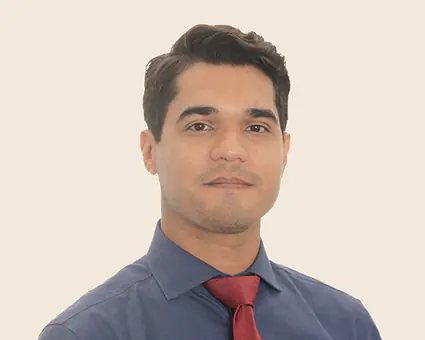
Dr Micael de Andrade Lima
BSc, MSc,PhD, FHEA
Senior Lecturer in Food Innovation
Food and Markets Department




Micael is a Senior Lecturer in Food Innovation at the Natural Resources Institute (NRI), University of Greenwich, where he has worked since 2021. He is Programme Leader for the MSc Food Innovation and MSc Food Innovation with Industrial Practice programmes and teaches across postgraduate programmes in Food Innovation and Applied Food Safety and Quality Management. He also supervises postgraduate research projects and leads the Postharvest Innovations Research Group (PHI).
Micael’s food science research includes the development of sustainable processing methods for recovering and purifying valuable compounds from biological resources and food-processing by-products. His work brings together food science, bioprocessing and sustainable food innovation, with an emphasis on translating scientific advances into practical applications.
At NRI, Micael has led and contributed to research projects exploring the valorisation of food-industry by-products and the development of sustainable food ingredients. His research has included work on plant protein recovery from brewer’s spent grain (BSG) and the purification of anthocyanins from berry-processing waste, reflecting his broader interest in improving resource efficiency and creating value from underutilised materials.
Alongside his research, Micael has a strong interest in pedagogical research and evidence-informed approaches to higher education. His work includes the development and application of assessment rubrics to promote clarity, consistency and transparency in assessment, support student learning, and improve feedback practices. Through his involvement in curriculum design and enhancement at the University of Greenwich, he has contributed to course design, validation and revalidation, as well as the development, review and continuous improvement of individual modules. His educational interests include assessment and feedback, curriculum innovation, and the responsible integration of generative AI into higher education.
Before joining the University of Greenwich, Micael worked for two years as a Lecturer in Food Science at Aberystwyth University’s Institute of Biological, Environmental and Rural Sciences (IBERS). Through its Distance Learning and Bioinnovation Wales programmes, he contributed to module development, validation, coordination, tutoring, assessment and moderation, including modules delivered in partnership with Swansea University.
Micael completed his PhD at the University of Reading in 2018, where he developed a sequential extraction and purification protocol for recovering phenolic compounds and carotenoids from vegetable waste using greener processing technologies. He subsequently undertook postdoctoral research at the Federal University of Ceará, Brazil, investigating the purification of R-phycoerythrin, a fluorescent protein derived from red algae with applications in biomedical research and diagnostics.
Research interests and specialist areas: Sustainable food processing; food ingredient innovation; bioprocessing; bioactive compounds; food waste valorisation; alternative proteins; pedagogical research; assessment and feedback; curriculum development.
Micael’s research explores how underutilised food resources and processing by-products can be transformed into valuable, functional ingredients through sustainable processing technologies. He is particularly interested in alternative proteins and the development of plant-based foods, investigating protein recovery from underexplored raw materials such as faba beans and brewer’s spent grain (BSG). His work examines protein functionality and rheological properties to understand how recovered ingredients can be incorporated into food products with desirable technological and quality characteristics.
His research also encompasses the recovery and purification of high-value bioactive compounds, including anthocyanins from berry-processing waste. Using approaches such as ultrasound-assisted and supercritical fluid extraction, liquid-phase adsorption, and ion-exchange and hydrophobic interaction chromatography, he investigates how processing conditions and downstream separation methods can improve recovery, concentration and purification.
Through projects such as BSG4PROTEIN and his work on anthocyanin purification, Micael contributes to the development of circular bioeconomy approaches that reduce waste, improve resource utilisation and create opportunities for higher-value applications within the food sector. Future research aims to advance scalable, resource-efficient processing strategies and support the development of sustainable food ingredients and products.
Micael leads the Postharvest Innovations Research Group (PHI) at NRI, University of Greenwich. His wider scholarly interests also include pedagogical research, particularly assessment rubric design, assessment and feedback practices, curriculum innovation, and the responsible use of generative AI in higher education.
- BSG4PROTEIN: Upcycling brewer’s spent grain for plant-based protein production, Starbucks/Hubbub (2025), £40k
- Purification of anthocyanins from berry waste via adsorption: a pilot study, QR (2025), £4k
- UK–Brazil partnership for exploring underutilised local plant sources for alternative protein production, REF (2024), £9k
- Upcycled plant proteins from brewer’s spent grain, REF (2023), £11k.
- Extraction of alternative protein from fava beans via novel technologies, HEIF UK, (2022), £10.5k.
Programmes:
- MSc Food Innovation
- MSc Food Innovation with Industrial Practice
- MSc Applied Food Safety and Quality Management
Modules:
- FOOD1023 Food Preservation
- FOOD1029 Food Product and Process Development
- FOOD1073 Alternative Proteins
- FOOD1074 Applied Food Science and Innovation
- FOOD1075 Branding, Innovation and Management
- FOOD1076 Advanced Food Analysis
- Reading Assessor for the Chevening Scholarships (2024-2026)
- Academic Advisor and Application Reviewer for the Commonwealth Scholarship Commission (2022 - 2024)
- Panellist of the scientific committee of the BBSRC’s London Interdisciplinary Doctoral Programme (LIDo) (2022 - 2024)
- Maia, Priscilla Lima, Rodrigues, Esiana de Almeida, Lima, Darliane da Silva, Lima, Cleidiane Gomes, Nobre, Crisiana de Andrade, Mendes, Luana Guabiraba, Martins, Jéssica Roberta Pereira, Damasceno, Marlene Nunes, de Andrade Lima, Micael and Milhome, Maria Aparecida Liberato (2026) Validation and application of QuEChERS–GC-MS and ICP-OES for multiresidue analysis of pesticides and metals in Brazilian grated coconut. Journal of Food Measurement and Characterization. ISSN 2193-4126 (Print), 2193-4134 (Online) (doi:10.1007/s11694-026-04903-9)
- Carneiro de Oliveira, Magnolia, Kelvyn de Oliveira, John, Brilhante Silva, Joselito, Guabiraba Mendes, Luana, Sousa da Silva, Felipe, Da Silva Alencar, Mairlane, De Andrade Nobre, Crisiana, Garcia Maia Costa, Mayra, De Andrade Lima, Micael and Aparecida Liberato Milhome, Aparecida (2024) Effect of thermal processing on the degradation of pesticides in a banana jam partially formulated with banana peel flour. Applied Food Research, 4 (2):100445. ISSN 2772-5022 (Online) (doi:10.1016/j.afres.2024.100445)
- Kipling, Richard P., Stiles, William A. V., De Andrade Lima, Micael, MacKintosh, Neil, Roberts, Meirion W., Williams, Cate L., Wootton-Beard, Peter C. and Watson-Jones, Sarah J. (2022) Interaction in online postgraduate learning: what makes a good forum? Distance Education, 44 (1). pp. 162-189. ISSN 0158-7919 (Print), 1475-0198 (Online) (doi:10.1080/01587919.2022.2150391)
- De Andrade Lima, Micael, Andreou, Rafaela, Charalampopoulos, Dimitris and Chatzifragkou, Afroditi (2021) Supercritical carbon dioxide extraction of phenolic compounds from potato (Solanum tuberosum) peels. Applied sciences, 11 (8):3410. ISSN 2076-3417 (Online) (doi:10.3390/app11083410)