
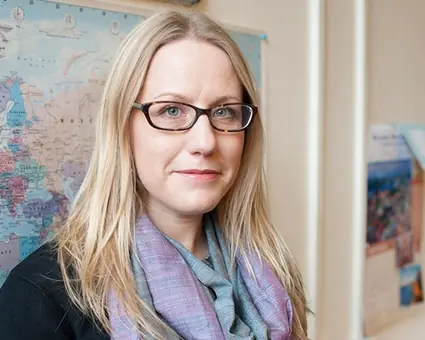
Dr Lora Forsythe
BA (Hons), MSc, PhD
Associate Professor in Gender, Inequalities and Food Systems
Livelihoods and Institutions Department
+44 (0)1634 88 3067





Lora is co-lead of the Gender and Social Difference programme and research group at the Natural Resources Institute. She is a social scientist with 20 years’ research experience in intersectional gender inequalities in the Global South and North. Her inter and transdisciplinary work is informed by a range of critical (feminist, intersectional and decolonial) theory and meaningful transnational engagement with practice and social movements, to understand (in)equity and transformative change in the context of agriculture, food and nature, to contribute to social and environmental justice. Lora’s current research is focused on gender-based violence (GBV), women’s climate action and gender and food systems, receiving grants from the AHRC and British Academy. Lora uses mixed and participatory methods (including the arts), including longitudinal interviewing, storywork and activist-led research). Experience throughout Africa, the Philippines, India, Central America, Brazil, Colombia, Canada and the UK.
Lora has a demonstrated track record for impactful research (e.g., H-Index 18), influencing global decision makers, and is a recipient of the University of Greenwich 2018 Outstanding Achievement in Research Award, with research contributing to the Queen’s Anniversary Prize in 2015. Lora has led several institutional and programme evaluations contributing to the strategic directions of the IDRC (Canada) and the Gender Platform of the CGIAR, as well as for civil society organisations such as ActionAid and Oxfam. Details of peer-reviewed publications available at Lora Forsythe – Google Scholar. Lora also contributes her expertise to teaching and learning activities at the Institute within the UK and internationally, including Master's programmes, facilitating departmental contributions to the NRI seminar series, delivery of short courses, and post graduate supervision.
- Gender-based violence (GBV) related with food systems and climate and environmental change
- Women’s collective action
- Gender, intersectionality and knowledge politics related with food systems and ecology
- Soil-human relations, from feminist perspective
- Participatory and feminist monitoring, evaluation and learning
Project PI Hitting the Ground: an international arts-led transdisciplinary partnership to address GBV in food systems through a body/story/environment approach (2024-2027). Funding from the Arts and Humanities Research Council UK. This project tackles the overlooked links between gender‑based violence (GBV) and food systems, where women often work in insecure, low‑paid and informal roles that heighten their vulnerability. To address the lack of evidence and appropriate research methods, the project creates an international, arts‑led partnership to develop a new body/story/environment methodology that captures women’s embodied and intersectional experiences of GBV in food systems in Colombia and Nigeria, the project co‑creates trauma‑informed, context‑specific research tools that generate multimodal narratives and artefacts that promote women’s dignity and support locally grounded policy and practice change. Overall, the project aims to reshape how GBV in food systems is understood and addressed, demonstrating the value of arts‑based research in driving social change.
Project PI Entangled Forests: Women’s climate action in the Brazilian Amazon and the Philippines (2024-2025). Funding from the British Academy. Entangled Forests is a research initiative amplifying the voices of women environmental defenders across the Brazilian Amazon and the Philippines. Interim findings presented in this booklet and webpage highlight women’s diverse strategies for resistance and collective care amid escalating climate threats and political pressures. Through testimonies, activist-led research, and storytelling, the project is revealing how women defenders in different geo-political spaces safeguard forests, rivers, and traditional knowledge while facing multiple threats to their lives and livelihoods. It calls for transformative policy action to ensure gender equity, environmental justice, and the protection of defenders as fundamental pillars of nature and human flourishing. Interim Findings presented at COP can be viewed here: Entangled Forests: Women’s climate action in the Brazilian Amazon and the Philippines
Project PI Women in Agrifood Systems in sub-Saharan Africa report (2025), published with FAO and AWARD with funding from IDRC and AGRA. Lead author or co-lead author of six out of seven chapters. This report builds on the momentum generated by FAO’s 2023 Status of Women in Agrifood Systems global report, and provides a comprehensive analysis of the status of women in agrifood systems in sub-Saharan Africa, highlighting their vital yet often undervalued roles. It explores how gender inequality intersects with climate change, environmental degradation, and socio-economic factors to impact women’s livelihoods, food security, and access to natural resources. Drawing on African-led research and stakeholder consultations, the report identifies persistent barriers and showcases transformative opportunities for gender equality. Key themes include women’s work, food security and nutrition, natural resource rights, climate impacts, innovation, and women’s agency and collective action. It emphasizes the need for gender-transformative policies, improved data, and inclusive governance to foster resilient, equitable, and sustainable agrifood systems. Full report launching in April 2026. Overview available here: https://doi.org/10.4060/cd6631en
Project PI Gender Just Landscapes: GBV and community protection in land, natural resource and climate conflicts (2022-2023). Funding from Creating Safer Space and Arts and Humanities Research Council, UK. The project sought to address critical gaps in knowledge on gender-based violence (GBV) in contexts of conflict, insecurity, and displacement by improving understanding of its prevalence, intersecting vulnerabilities, and the factors that shape resilience. The project also aimed to identify community-led responses and local protection infrastructures that help reduce GBV risks and support those affected by violence. Through comparative case studies in Colombia, Nigeria, and the Philippines, we employed visual and participatory action research methods to explore how communities experience, understand, and respond to GBV. By documenting local knowledge, practices, and protection strategies, the project generated insights that can inform Unarmed Civilian Protection (UCP) practitioners and other actors seeking to strengthen community-centred approaches to safety, protection, and violence prevention.
Co-lead an independent evaluation of the Evidence Module of the CGIAR GENDER Platform (2022-2023). The evaluation assessed the GENDER Platform’s Evidence Module in generating and mobilising evidence on gender equality and women’s empowerment in agri-food systems. The evaluation used mixed methods, including stakeholder interviews, surveys, and document review, to assess progress, effectiveness, relevance, and impact, and to develop recommendations for future CGIAR gender research and programming. All recommendations from the evaluation were adopted. Full report available.
Co-lead a review of practical resources for Gender and Climate Resilient Agriculture research (2022), CGIAR Gender Platform, CGIAR. This project reviewed the evidence, concepts, and practical tools needed to support gender-transformative approaches to climate-resilient agriculture (CRA). Conducted for the CGIAR GENDER Impact Platform, the research assessed 44 tools, methods, and guidance resources used by researchers and practitioners to address the intersections of gender inequality, climate change, and agricultural development. The project developed a conceptual framework for analysing gender dimensions within climate resilience, identified key gaps in existing resources, and highlighted opportunities to strengthen gender-responsive and transformative approaches to climate-resilient agriculture policy, research, and practice. The review can be found here.
Leader of Work Package on understanding the drivers of trait preferences and the development of multi-user Root Tuber and Banana (RTB) product profiles, as part of the RTB Products for End User Preferences (RTBfoods) Project (2017 - present). The work package involves interdisciplinary teams of food technologists, economists and gender specialists in conducting innovative research along RTB value chains to help inform breeding priorities. The project scope includes the study of cassava, yam, sweet potato, plantain and tropical potato value chains across Benin, Cameroon, Ivory Coast, Nigeria and Uganda. Profiling the preferences of value chain actors with their gender-differentiated trait and product preferences, in addition to examining household decision making in relation to varietal preferences, is expected to support breeding programmes in improving the adoption of new varieties and to help ensure food security and income generation across sub-Saharan Africa.
Using Information Communication Technologies (ICTs) to understand the relationships between labour-saving agricultural innovations, women’s time use and maternal and child nutrition outcomes in Uganda (2016 – present). Gender Lead for the study of the impact of labour-saving technology on women’s time use and nutrition outcomes, and the effectiveness of different ICTs in measuring time use and lifestyle data in the context of agri-nutrition interventions. Two inter-disciplinary digital tools, GPS wearable cameras and interactive voice response diaries will be trialled for use in Uganda. The research is being conducted in partnership with the London School of Health and Tropical Medicine.
Evaluation of Oxfam’s Female Food Hero project in Ethiopia (2016 – 2017). Designed and led an advocacy evaluation of Oxfam's Female Food Hero project in Ethiopia. The evaluation involved interviews with female food heroes, policy makers and local stakeholders. A contribution tracing approach was used for the methodology. A paper and blog about conducting advocacy work in closed-political contexts is under development and will be presented at the American Evaluation Association Annual Conference in late 2017.
Gender-Responsive Researchers Equipped for Agricultural Transformation (GREAT) programme (2016-2017). Trainer, lecturer and mentor for conducting gender-responsive research in agriculture, in order to improve the outcomes for smallholder women farmers, entrepreneurs and farmer organisations.
Gender and Livelihoods Researcher, Optimising Cassava Processing Technology, in partnership with CIAT, IITA and CIRAD (2014-present). Qualitative research on the socio-economic and gender impacts of enhancing cassava processing technology conducted under the CGIAR Research Program on Roots, Tubers and Bananas (RTB) in Nigeria. This work complements research undertaken in Cassava Growth Markets and C:AVA projects (described below).
Work Package Leader (Gender and Livelihoods), European Commission, Cassava Growth Markets (2012 - 2017), Nigeria, Malawi, Uganda. Work Package leader on 'maximising gender and livelihood impacts of value chain development of cassava'. Country focus: Nigeria, Uganda and Malawi. This work package will provide insights into possible shifts in power relations and access to resources as market-led innovations enter the value chain. This work also aims to collect good practice on making markets work for the poor. Research is mixed-method.
Lead researcher (land rights and governance papers), Researcher (resilience) on Gender and Drylands Development: Empowering Women for Change series (2015), UNDP and UNCCD. The UNDP Global Policy Centre on Resilient Ecosystems and Desertification and the UN Convention to Combat Desertification (UNCCD) commissioned an extensive review of research on three key topics relating to dryland women's empowerment, namely land rights, governance and resilience. The findings were presented at the UNCCD Conference of Parties (COP) 12 in Ankara, Three thematic papers were produced, as well as accompanying policy briefs and an overall synthesis paper.
Gender and Diversity Specialist, Yam Improvement for Income and Food Security in West Africa (YIIFSWA) Project, Nigeria and Ghana (2013-2014). Providing expertise and backstopping support for a comprehensive gender and social difference situational analysis in Nigeria and Ghana, and contributing to strategy development for yam value chains in the two countries.
Gender and Diversity Specialist, Bill and Melinda Gates Foundation, Cassava: Adding Value for Agriculture (C:AVA) Project (2008 - 2014), Nigeria, Malawi, Uganda, Tanzania, Ghana. Delivered the gender and diversity component of the C:AVA funded by the Bill and Melissa Gates Foundation. Work included the development of research methodologies, conducting gender and diversity audits of implementing partner organisations and delivery of capacity-strengthening to partners.
Gender and Diversity Specialist, FCDO/ combined European donors and MCA / MCC, Community Land Initiative (2008-2014), Mozambique. Technical assistance in gender and community engagement, including development of a gender and diversity strategy, delivery of community engagement training, and development and management of a cascading training of trainers programme for service providers and communities.
Evaluation Team Leader, ActionAid, Evaluation of Women's Rights to Land Project (2013), India, Sierra Leone and Guatemala. The programme aimed to support women's movements from marginalised communities, including indigenous women in Guatemala, Dalit women in India, and women living with HIV/AIDS in Sierra Leone, to improve their access and control over land. The programme ran from 2010 to 2013 was funded by the EC.
Evaluator, IDRC and CIDA, Mid-term evaluation of the Canadian International Food Security Research Fund (CIFSRF) (2012). One of three team members undertaking an evaluation of CIFSRF, providing funding to Canadian and Southern partners to develop projects in research for food security and nutrition in Africa, Asia and Latin America. The mid-term evaluation examines programme strategy, programme management and project progress.
Lead Researcher, McKnight Foundation, Beliefs and taboos of bambara groundnut (2012), Malawi. Study on the beliefs and taboos of bambara groundnut and gender issues in Malawi to inform bambara value chain project interventions in Southern Africa, including the collection of data on the uses of bambara, local recipes, and developing a community engagement strategy.
Project leader, Concern Worldwide, Farming for Impact (2011), Rwanda. Project leader and led researcher on a study on promising practices supporting resource-poor and vulnerable smallholder farmers to improve food security and reduce poverty in Rwanda. Resulting in publication and a presentation in UK parliament.
Project leader, FCDO, Women's Participation in Higher Education for SCARDA (2010-2011). Work for Strengthening Capacity for Agricultural Research and Development in Africa (SCARDA) also included a gender and diversity mainstreaming review of project activities.
Module Leader ‘Gender, inequalities, and social difference’ for the MSc Transformative Change for Sustainable Development, Faculty of Engineering & Science.
- Co-NRI representative to the International Land Coalition
- Mentor for African Women in Agricultural Research and Development (AWARD)
- Member of the Association of Women’s rights In Development (AWID)
- Member of the Violence against Women and Girls Research Network
- Member of the Gender, Policy and Practice and Women and Development with the Development Studies Association
- Member of the International Association for Feminist Economics
Former roles:
- NRI representative Decolonising Research & Knowledge Exchange working group University of Greenwich
- NRI Ethics Representative and Faculty Ethics Committee member
- Rincón Flórez, J., López Castañeda, D., and L. Forsythe (forthcoming). Guardianas del Agua del Putumayo: climate change, the energy transition and social mobilisation led by women in high-risk territories. Gender and Development.
- Forsythe, L. and A. Martin (forthcoming). Women's everyday innovation: care and commoning strategies in Nigeria and Malawi, in Gender Equality in Agricultural Systems: The Long Wait for the Underserved and Overlooked. Deborah Rubin, Cristina Manfre, Bimbika Sijapati Basnett, Caitlin Nordehn (eds). CABI.
- Kiven James Kewir, Rebecca Lorins, Lora Forsythe, and Aliyu Barau (forthcoming). Capturing experiences: Arts-based and creative methods in the study of community-led unarmed civilian protection, in Unarmed Community Self-Protection and Nonviolent Resistance: Experiences from Africa, Latin America, the Middle East and Southeast Asia. Eds: Beatriz E. Arias López, Berit Bliesemann de Guevara, Rachel Julian, Nerve V. Macaspac, and Rosemary Okello-Orlale. Bristol University Press.
- FAO, NRI and AWARD (2026). Women in Agrifood systems in sub-Saharan Africa. FAO. Overall report technical lead and chapter lead/co-lead for the chapters on food security; natural resource rights and climate and environmental change; women’s agency, collective action and social movements, and the recommendations.
- Forsythe, L. (2023) The links between gender and food insecurity. WOW Helpdesk Query 79. London: Social Development Direct.
- Forsythe, L., et al., (2024). A case of transdisciplinarity and collaborative decision making: the co-construction of Gendered Food Product Profiles. Journal of the Science of Food and Agriculture. DOI: https://doi.org/10.1002/jsfa.13460
- Forsythe, L., T. Stathers (2023): Evaluation of CGIAR GENDER (Generating Evidence and New Directions for Equitable Results) Platform Evidence Module, Report. Rome: IAES Evaluation Function.
- Nelson, V. and Forsythe, L. 2023. Gender and climate-resilient agriculture: A review of concepts and practical resources in support of gender-transformative change. CGIAR GENDER Impact Platform Working Paper #018. Nairobi, Kenya: CGIAR GENDER Impact Platform.
- Contributing GBV expert. FAO (2023). The status of women in agrifood systems. Rome. DOI: 10.4060/cc5343en
- Forsythe, L. (2023) Gender-based violence in food systems. Nature Food, 4: 472–475. DOI: 0.1038/s43016-023-00777-y
- Bulungu ALS, Palla L, Priebe J, Forsythe L, Katic P, Varley G, Galinda BD, Sarah N, Nambooze J, Wellard K, Ferguson EL. (2022) Validation of an Automated Wearable Camera-Based Image-Assisted Recall Method and the 24-h Recall Method for Assessing Women’s Time Allocation in a Nutritionally Vulnerable Population: The Case of Rural Uganda. Nutrients 14(9):1833. https://doi.org/10.3390/nu14091833
- Quan, J., Forsythe, L., Po, J. (2021). Advancing women’s position by recognising and strengthening customary land rights in Land Governance and Gender. Namibia: CABI. DOI: 10.1079/9781789247664.0006
- Bulungu, A.L.S., Palla, L., Priebe, J., Forsythe, L., Katic, P., Varley. G., Galinda, B.D. Sarah, N., Nambooze, J., Wellard, K., Ferguson, E.L. (2021) Validation of a life-logging wearable camera method and the 24-hour diet recall method for assessing maternal and child dietary diversity. British Journal of Nutrition. DOI: 10.1017/S0007114520003530
- Picchioni, F., Po, J. Forsythe, L (2021). Strengthening resilience in response to COVID-19: A call to integrate social reproduction in sustainable food systems Canadian Journal of Development Studies. DOI: 10.1080/02255189.2020.1858761
- Forsythe, L., Tufan, H., Bouniol, A., Kleih, U., and Fliedel, G. (2021). An interdisciplinary and participatory methodology to improve user acceptability of root, tuber and banana varieties through development of food product profiles quality characteristics. International Journal of Food Science and Technology, 56:1. (Online) DOI: 10.1111/ijfs.14680
- Aurélie Bechoff, Lora Forsythe, Maria Njau, Adrienne Martin, Gaspar Audifas, Adebayo Abass & Keith Tomlins (2020) Women Eat More Rice and Banana: The Influence of Gender and Migration on Staple Food Choice in East Africa, Ecology of Food and Nutrition, 59:5, 506-524, DOI: 10.1080/03670244.2020.1755278
- Kawarazuka, N., Prain, N., Forsythe, L., Mayanja, S., Mudege, N., Babini, C. and Polar, V. (2018) Gender in Agricultural Mechanization: key guiding questions.
- Forsythe, L., Njau, M., Martin, A., Bechoff, A. and Tomlins, K. (2017) Staple food cultures: a case study of cassava ugali preferences in Dar es Salaam, Tanzania. Natural Resources Institute and CGIAR Research Program on Roots, Tubers and Bananas (RTB). RTB Working Paper.
- Forsythe, L., Posthumus, H. and Martin, A. (2016) A crop of one's own? Women's experiences of cassava commercialization in Nigeria and Malawi. Journal of Gender, Agriculture and Food Security, 1 (2):2. pp. 110-128. ISSN 2413-922X (Online)
- Forsythe, L., Martin, A.M. and Posthumus, H. (2015) Cassava market development: a path to women's empowerment or business as usual? Food Chain, 5 (1-2). pp. 11-27. ISSN 2046-1879 (Print), 2046-1887 (Online) (doi:10.3362/2046-1887.2015.003)
- Gender and Drylands Development - Empowering Women for Change Series:
- Nelson, V., Forsythe, L., and Morton, J. (2015) Synthesis of thematic papers from the series 'Women's empowerment in the drylands. UNCCD and UNDP, Greenwich.
- Forsythe, L., Morton, J., Nelson, V., Quan, J., Martin, A. and Hartog, M. (2015) Strengthening dryland women's land rights: local contexts, global change. UNCCD, UNDP, Greenwich.
- Forsythe, L., Morton, J., Nelson, V., Martin, A. and Hartog, M. (2015) Gender and drylands governance: Empowering women for change. UNDP, UNCCD, Greenwich.
- Nelson, V., Morton, J., Forsythe, L., Martin, A. and Hartog, M. (2015) Achieving dryland women's empowerment: environmental resilience and social transformation. UNCCD, UNDP, Greenwich.
- Forsythe, L., Manda, M. N., Mwangwela, A.M. and Bennett, B. (2015) Beliefs, taboos and minor crop value chains: the case of Bambara Groundnut in Malawi. Food, Culture and Society, 18 (3). pp. 501-517. ISSN 1552-8014 (Print), 1751-7443 (Online) (doi:10.1080/15528014.2015.1043112).
- Forsythe, L. and Wellard, K. (2014) Final Evaluation for Women's Right to Land Project for ActionAid.
- Forsythe, L., and Willoughby, R. (2011) Farming for Impact: A case study of Smallholder agriculture in Rwanda. Concern Worldwide.
- Forsythe, L., Kaitano, V. and A.M. Martin (2010) Gender and Diversity Audit Malawi.
- Forsythe, L., Mangheni, N. and Martin, A.M. (2010) Women in Higher Agricultural Education, RUFORUM.
- Forsythe, L., Martin, A.M. and Stathers, T. (2010) Gender and Diversity summary recommendations for the Great Lakes Cassava Initiative.
- Forsythe, L., Martin, A.M. and Stathers, T. (2010) Gender and Diversity summary report for the Great Lakes Cassava Initiative.
- Forsythe, L., Shayo, R. and Martin, A.M. (2010) Gender and Diversity Audit, Tanzania. C:AVA and GLCI Projects.
- Kopiyo, G. and Forsythe, L. (2010) Great Lakes Cassava Initiative Gender and Diversity Audit Kenya.
- Mangheni, M., Ekirikubinza- Tibatemwa, L. and Forsythe, L. (2010) Gender issues in agricultural education within African universities. Gender Background Paper for the Ministerial Conference on Higher Education in Agriculture in Africa.
- Mukasa, B. Forsythe, L. and Martin, A.M. (2010) Gender and Diversity Audit Report for Great Lakes Cassava Initiative and Cassava: Adding Value for Africa. Uganda.
- Forsythe, L., Abdulsalam-Saghir, P. and Martin, A.M. (2009) Gender and Diversity Audit Nigeria.
- Forsythe, L., Quartey, Q., and Martin, A.M. (2009) Gender and Diversity Audit Ghana.
Lora is co-lead of the Gender and Social Difference programme and research group at the Natural Resources Institute. She is a social scientist with 20 years’ research experience in intersectional gender inequalities in the Global South and North. Her inter and transdisciplinary work is informed by a range of critical (feminist, intersectional and decolonial) theory and meaningful transnational engagement with practice and social movements, to understand (in)equity and transformative change in the context of agriculture, food and nature, to contribute to social and environmental justice. Lora’s current research is focused on gender-based violence (GBV), women’s climate action and gender and food systems, receiving grants from the AHRC and British Academy. Lora uses mixed and participatory methods (including the arts), including longitudinal interviewing, storywork and activist-led research). Experience throughout Africa, the Philippines, India, Central America, Brazil, Colombia, Canada and the UK.
Lora has a demonstrated track record for impactful research (e.g., H-Index 18), influencing global decision makers, and is a recipient of the University of Greenwich 2018 Outstanding Achievement in Research Award, with research contributing to the Queen’s Anniversary Prize in 2015. Lora has led several institutional and programme evaluations contributing to the strategic directions of the IDRC (Canada) and the Gender Platform of the CGIAR, as well as for civil society organisations such as ActionAid and Oxfam. Details of peer-reviewed publications available at Lora Forsythe – Google Scholar. Lora also contributes her expertise to teaching and learning activities at the Institute within the UK and internationally, including Master's programmes, facilitating departmental contributions to the NRI seminar series, delivery of short courses, and post graduate supervision.
- Gender-based violence (GBV) related with food systems and climate and environmental change
- Women’s collective action
- Gender, intersectionality and knowledge politics related with food systems and ecology
- Soil-human relations, from feminist perspective
- Participatory and feminist monitoring, evaluation and learning
Project PI Hitting the Ground: an international arts-led transdisciplinary partnership to address GBV in food systems through a body/story/environment approach (2024-2027). Funding from the Arts and Humanities Research Council UK. This project tackles the overlooked links between gender‑based violence (GBV) and food systems, where women often work in insecure, low‑paid and informal roles that heighten their vulnerability. To address the lack of evidence and appropriate research methods, the project creates an international, arts‑led partnership to develop a new body/story/environment methodology that captures women’s embodied and intersectional experiences of GBV in food systems in Colombia and Nigeria, the project co‑creates trauma‑informed, context‑specific research tools that generate multimodal narratives and artefacts that promote women’s dignity and support locally grounded policy and practice change. Overall, the project aims to reshape how GBV in food systems is understood and addressed, demonstrating the value of arts‑based research in driving social change.
Project PI Entangled Forests: Women’s climate action in the Brazilian Amazon and the Philippines (2024-2025). Funding from the British Academy. Entangled Forests is a research initiative amplifying the voices of women environmental defenders across the Brazilian Amazon and the Philippines. Interim findings presented in this booklet and webpage highlight women’s diverse strategies for resistance and collective care amid escalating climate threats and political pressures. Through testimonies, activist-led research, and storytelling, the project is revealing how women defenders in different geo-political spaces safeguard forests, rivers, and traditional knowledge while facing multiple threats to their lives and livelihoods. It calls for transformative policy action to ensure gender equity, environmental justice, and the protection of defenders as fundamental pillars of nature and human flourishing. Interim Findings presented at COP can be viewed here: Entangled Forests: Women’s climate action in the Brazilian Amazon and the Philippines
Project PI Women in Agrifood Systems in sub-Saharan Africa report (2025), published with FAO and AWARD with funding from IDRC and AGRA. Lead author or co-lead author of six out of seven chapters. This report builds on the momentum generated by FAO’s 2023 Status of Women in Agrifood Systems global report, and provides a comprehensive analysis of the status of women in agrifood systems in sub-Saharan Africa, highlighting their vital yet often undervalued roles. It explores how gender inequality intersects with climate change, environmental degradation, and socio-economic factors to impact women’s livelihoods, food security, and access to natural resources. Drawing on African-led research and stakeholder consultations, the report identifies persistent barriers and showcases transformative opportunities for gender equality. Key themes include women’s work, food security and nutrition, natural resource rights, climate impacts, innovation, and women’s agency and collective action. It emphasizes the need for gender-transformative policies, improved data, and inclusive governance to foster resilient, equitable, and sustainable agrifood systems. Full report launching in April 2026. Overview available here: https://doi.org/10.4060/cd6631en
Project PI Gender Just Landscapes: GBV and community protection in land, natural resource and climate conflicts (2022-2023). Funding from Creating Safer Space and Arts and Humanities Research Council, UK. The project sought to address critical gaps in knowledge on gender-based violence (GBV) in contexts of conflict, insecurity, and displacement by improving understanding of its prevalence, intersecting vulnerabilities, and the factors that shape resilience. The project also aimed to identify community-led responses and local protection infrastructures that help reduce GBV risks and support those affected by violence. Through comparative case studies in Colombia, Nigeria, and the Philippines, we employed visual and participatory action research methods to explore how communities experience, understand, and respond to GBV. By documenting local knowledge, practices, and protection strategies, the project generated insights that can inform Unarmed Civilian Protection (UCP) practitioners and other actors seeking to strengthen community-centred approaches to safety, protection, and violence prevention.
Co-lead an independent evaluation of the Evidence Module of the CGIAR GENDER Platform (2022-2023). The evaluation assessed the GENDER Platform’s Evidence Module in generating and mobilising evidence on gender equality and women’s empowerment in agri-food systems. The evaluation used mixed methods, including stakeholder interviews, surveys, and document review, to assess progress, effectiveness, relevance, and impact, and to develop recommendations for future CGIAR gender research and programming. All recommendations from the evaluation were adopted. Full report available.
Co-lead a review of practical resources for Gender and Climate Resilient Agriculture research (2022), CGIAR Gender Platform, CGIAR. This project reviewed the evidence, concepts, and practical tools needed to support gender-transformative approaches to climate-resilient agriculture (CRA). Conducted for the CGIAR GENDER Impact Platform, the research assessed 44 tools, methods, and guidance resources used by researchers and practitioners to address the intersections of gender inequality, climate change, and agricultural development. The project developed a conceptual framework for analysing gender dimensions within climate resilience, identified key gaps in existing resources, and highlighted opportunities to strengthen gender-responsive and transformative approaches to climate-resilient agriculture policy, research, and practice. The review can be found here.
Leader of Work Package on understanding the drivers of trait preferences and the development of multi-user Root Tuber and Banana (RTB) product profiles, as part of the RTB Products for End User Preferences (RTBfoods) Project (2017 - present). The work package involves interdisciplinary teams of food technologists, economists and gender specialists in conducting innovative research along RTB value chains to help inform breeding priorities. The project scope includes the study of cassava, yam, sweet potato, plantain and tropical potato value chains across Benin, Cameroon, Ivory Coast, Nigeria and Uganda. Profiling the preferences of value chain actors with their gender-differentiated trait and product preferences, in addition to examining household decision making in relation to varietal preferences, is expected to support breeding programmes in improving the adoption of new varieties and to help ensure food security and income generation across sub-Saharan Africa.
Using Information Communication Technologies (ICTs) to understand the relationships between labour-saving agricultural innovations, women’s time use and maternal and child nutrition outcomes in Uganda (2016 – present). Gender Lead for the study of the impact of labour-saving technology on women’s time use and nutrition outcomes, and the effectiveness of different ICTs in measuring time use and lifestyle data in the context of agri-nutrition interventions. Two inter-disciplinary digital tools, GPS wearable cameras and interactive voice response diaries will be trialled for use in Uganda. The research is being conducted in partnership with the London School of Health and Tropical Medicine.
Evaluation of Oxfam’s Female Food Hero project in Ethiopia (2016 – 2017). Designed and led an advocacy evaluation of Oxfam's Female Food Hero project in Ethiopia. The evaluation involved interviews with female food heroes, policy makers and local stakeholders. A contribution tracing approach was used for the methodology. A paper and blog about conducting advocacy work in closed-political contexts is under development and will be presented at the American Evaluation Association Annual Conference in late 2017.
Gender-Responsive Researchers Equipped for Agricultural Transformation (GREAT) programme (2016-2017). Trainer, lecturer and mentor for conducting gender-responsive research in agriculture, in order to improve the outcomes for smallholder women farmers, entrepreneurs and farmer organisations.
Gender and Livelihoods Researcher, Optimising Cassava Processing Technology, in partnership with CIAT, IITA and CIRAD (2014-present). Qualitative research on the socio-economic and gender impacts of enhancing cassava processing technology conducted under the CGIAR Research Program on Roots, Tubers and Bananas (RTB) in Nigeria. This work complements research undertaken in Cassava Growth Markets and C:AVA projects (described below).
Work Package Leader (Gender and Livelihoods), European Commission, Cassava Growth Markets (2012 - 2017), Nigeria, Malawi, Uganda. Work Package leader on 'maximising gender and livelihood impacts of value chain development of cassava'. Country focus: Nigeria, Uganda and Malawi. This work package will provide insights into possible shifts in power relations and access to resources as market-led innovations enter the value chain. This work also aims to collect good practice on making markets work for the poor. Research is mixed-method.
Lead researcher (land rights and governance papers), Researcher (resilience) on Gender and Drylands Development: Empowering Women for Change series (2015), UNDP and UNCCD. The UNDP Global Policy Centre on Resilient Ecosystems and Desertification and the UN Convention to Combat Desertification (UNCCD) commissioned an extensive review of research on three key topics relating to dryland women's empowerment, namely land rights, governance and resilience. The findings were presented at the UNCCD Conference of Parties (COP) 12 in Ankara, Three thematic papers were produced, as well as accompanying policy briefs and an overall synthesis paper.
Gender and Diversity Specialist, Yam Improvement for Income and Food Security in West Africa (YIIFSWA) Project, Nigeria and Ghana (2013-2014). Providing expertise and backstopping support for a comprehensive gender and social difference situational analysis in Nigeria and Ghana, and contributing to strategy development for yam value chains in the two countries.
Gender and Diversity Specialist, Bill and Melinda Gates Foundation, Cassava: Adding Value for Agriculture (C:AVA) Project (2008 - 2014), Nigeria, Malawi, Uganda, Tanzania, Ghana. Delivered the gender and diversity component of the C:AVA funded by the Bill and Melissa Gates Foundation. Work included the development of research methodologies, conducting gender and diversity audits of implementing partner organisations and delivery of capacity-strengthening to partners.
Gender and Diversity Specialist, FCDO/ combined European donors and MCA / MCC, Community Land Initiative (2008-2014), Mozambique. Technical assistance in gender and community engagement, including development of a gender and diversity strategy, delivery of community engagement training, and development and management of a cascading training of trainers programme for service providers and communities.
Evaluation Team Leader, ActionAid, Evaluation of Women's Rights to Land Project (2013), India, Sierra Leone and Guatemala. The programme aimed to support women's movements from marginalised communities, including indigenous women in Guatemala, Dalit women in India, and women living with HIV/AIDS in Sierra Leone, to improve their access and control over land. The programme ran from 2010 to 2013 was funded by the EC.
Evaluator, IDRC and CIDA, Mid-term evaluation of the Canadian International Food Security Research Fund (CIFSRF) (2012). One of three team members undertaking an evaluation of CIFSRF, providing funding to Canadian and Southern partners to develop projects in research for food security and nutrition in Africa, Asia and Latin America. The mid-term evaluation examines programme strategy, programme management and project progress.
Lead Researcher, McKnight Foundation, Beliefs and taboos of bambara groundnut (2012), Malawi. Study on the beliefs and taboos of bambara groundnut and gender issues in Malawi to inform bambara value chain project interventions in Southern Africa, including the collection of data on the uses of bambara, local recipes, and developing a community engagement strategy.
Project leader, Concern Worldwide, Farming for Impact (2011), Rwanda. Project leader and led researcher on a study on promising practices supporting resource-poor and vulnerable smallholder farmers to improve food security and reduce poverty in Rwanda. Resulting in publication and a presentation in UK parliament.
Project leader, FCDO, Women's Participation in Higher Education for SCARDA (2010-2011). Work for Strengthening Capacity for Agricultural Research and Development in Africa (SCARDA) also included a gender and diversity mainstreaming review of project activities.
Module Leader ‘Gender, inequalities, and social difference’ for the MSc Transformative Change for Sustainable Development, Faculty of Engineering & Science.
- Co-NRI representative to the International Land Coalition
- Mentor for African Women in Agricultural Research and Development (AWARD)
- Member of the Association of Women’s rights In Development (AWID)
- Member of the Violence against Women and Girls Research Network
- Member of the Gender, Policy and Practice and Women and Development with the Development Studies Association
- Member of the International Association for Feminist Economics
Former roles:
- NRI representative Decolonising Research & Knowledge Exchange working group University of Greenwich
- NRI Ethics Representative and Faculty Ethics Committee member
- Rincón Flórez, J., López Castañeda, D., and L. Forsythe (forthcoming). Guardianas del Agua del Putumayo: climate change, the energy transition and social mobilisation led by women in high-risk territories. Gender and Development.
- Forsythe, L. and A. Martin (forthcoming). Women's everyday innovation: care and commoning strategies in Nigeria and Malawi, in Gender Equality in Agricultural Systems: The Long Wait for the Underserved and Overlooked. Deborah Rubin, Cristina Manfre, Bimbika Sijapati Basnett, Caitlin Nordehn (eds). CABI.
- Kiven James Kewir, Rebecca Lorins, Lora Forsythe, and Aliyu Barau (forthcoming). Capturing experiences: Arts-based and creative methods in the study of community-led unarmed civilian protection, in Unarmed Community Self-Protection and Nonviolent Resistance: Experiences from Africa, Latin America, the Middle East and Southeast Asia. Eds: Beatriz E. Arias López, Berit Bliesemann de Guevara, Rachel Julian, Nerve V. Macaspac, and Rosemary Okello-Orlale. Bristol University Press.
- FAO, NRI and AWARD (2026). Women in Agrifood systems in sub-Saharan Africa. FAO. Overall report technical lead and chapter lead/co-lead for the chapters on food security; natural resource rights and climate and environmental change; women’s agency, collective action and social movements, and the recommendations.
- Forsythe, L. (2023) The links between gender and food insecurity. WOW Helpdesk Query 79. London: Social Development Direct.
- Forsythe, L., et al., (2024). A case of transdisciplinarity and collaborative decision making: the co-construction of Gendered Food Product Profiles. Journal of the Science of Food and Agriculture. DOI: https://doi.org/10.1002/jsfa.13460
- Forsythe, L., T. Stathers (2023): Evaluation of CGIAR GENDER (Generating Evidence and New Directions for Equitable Results) Platform Evidence Module, Report. Rome: IAES Evaluation Function.
- Nelson, V. and Forsythe, L. 2023. Gender and climate-resilient agriculture: A review of concepts and practical resources in support of gender-transformative change. CGIAR GENDER Impact Platform Working Paper #018. Nairobi, Kenya: CGIAR GENDER Impact Platform.
- Contributing GBV expert. FAO (2023). The status of women in agrifood systems. Rome. DOI: 10.4060/cc5343en
- Forsythe, L. (2023) Gender-based violence in food systems. Nature Food, 4: 472–475. DOI: 0.1038/s43016-023-00777-y
- Bulungu ALS, Palla L, Priebe J, Forsythe L, Katic P, Varley G, Galinda BD, Sarah N, Nambooze J, Wellard K, Ferguson EL. (2022) Validation of an Automated Wearable Camera-Based Image-Assisted Recall Method and the 24-h Recall Method for Assessing Women’s Time Allocation in a Nutritionally Vulnerable Population: The Case of Rural Uganda. Nutrients 14(9):1833. https://doi.org/10.3390/nu14091833
- Quan, J., Forsythe, L., Po, J. (2021). Advancing women’s position by recognising and strengthening customary land rights in Land Governance and Gender. Namibia: CABI. DOI: 10.1079/9781789247664.0006
- Bulungu, A.L.S., Palla, L., Priebe, J., Forsythe, L., Katic, P., Varley. G., Galinda, B.D. Sarah, N., Nambooze, J., Wellard, K., Ferguson, E.L. (2021) Validation of a life-logging wearable camera method and the 24-hour diet recall method for assessing maternal and child dietary diversity. British Journal of Nutrition. DOI: 10.1017/S0007114520003530
- Picchioni, F., Po, J. Forsythe, L (2021). Strengthening resilience in response to COVID-19: A call to integrate social reproduction in sustainable food systems Canadian Journal of Development Studies. DOI: 10.1080/02255189.2020.1858761
- Forsythe, L., Tufan, H., Bouniol, A., Kleih, U., and Fliedel, G. (2021). An interdisciplinary and participatory methodology to improve user acceptability of root, tuber and banana varieties through development of food product profiles quality characteristics. International Journal of Food Science and Technology, 56:1. (Online) DOI: 10.1111/ijfs.14680
- Aurélie Bechoff, Lora Forsythe, Maria Njau, Adrienne Martin, Gaspar Audifas, Adebayo Abass & Keith Tomlins (2020) Women Eat More Rice and Banana: The Influence of Gender and Migration on Staple Food Choice in East Africa, Ecology of Food and Nutrition, 59:5, 506-524, DOI: 10.1080/03670244.2020.1755278
- Kawarazuka, N., Prain, N., Forsythe, L., Mayanja, S., Mudege, N., Babini, C. and Polar, V. (2018) Gender in Agricultural Mechanization: key guiding questions.
- Forsythe, L., Njau, M., Martin, A., Bechoff, A. and Tomlins, K. (2017) Staple food cultures: a case study of cassava ugali preferences in Dar es Salaam, Tanzania. Natural Resources Institute and CGIAR Research Program on Roots, Tubers and Bananas (RTB). RTB Working Paper.
- Forsythe, L., Posthumus, H. and Martin, A. (2016) A crop of one's own? Women's experiences of cassava commercialization in Nigeria and Malawi. Journal of Gender, Agriculture and Food Security, 1 (2):2. pp. 110-128. ISSN 2413-922X (Online)
- Forsythe, L., Martin, A.M. and Posthumus, H. (2015) Cassava market development: a path to women's empowerment or business as usual? Food Chain, 5 (1-2). pp. 11-27. ISSN 2046-1879 (Print), 2046-1887 (Online) (doi:10.3362/2046-1887.2015.003)
- Gender and Drylands Development - Empowering Women for Change Series:
- Nelson, V., Forsythe, L., and Morton, J. (2015) Synthesis of thematic papers from the series 'Women's empowerment in the drylands. UNCCD and UNDP, Greenwich.
- Forsythe, L., Morton, J., Nelson, V., Quan, J., Martin, A. and Hartog, M. (2015) Strengthening dryland women's land rights: local contexts, global change. UNCCD, UNDP, Greenwich.
- Forsythe, L., Morton, J., Nelson, V., Martin, A. and Hartog, M. (2015) Gender and drylands governance: Empowering women for change. UNDP, UNCCD, Greenwich.
- Nelson, V., Morton, J., Forsythe, L., Martin, A. and Hartog, M. (2015) Achieving dryland women's empowerment: environmental resilience and social transformation. UNCCD, UNDP, Greenwich.
- Forsythe, L., Manda, M. N., Mwangwela, A.M. and Bennett, B. (2015) Beliefs, taboos and minor crop value chains: the case of Bambara Groundnut in Malawi. Food, Culture and Society, 18 (3). pp. 501-517. ISSN 1552-8014 (Print), 1751-7443 (Online) (doi:10.1080/15528014.2015.1043112).
- Forsythe, L. and Wellard, K. (2014) Final Evaluation for Women's Right to Land Project for ActionAid.
- Forsythe, L., and Willoughby, R. (2011) Farming for Impact: A case study of Smallholder agriculture in Rwanda. Concern Worldwide.
- Forsythe, L., Kaitano, V. and A.M. Martin (2010) Gender and Diversity Audit Malawi.
- Forsythe, L., Mangheni, N. and Martin, A.M. (2010) Women in Higher Agricultural Education, RUFORUM.
- Forsythe, L., Martin, A.M. and Stathers, T. (2010) Gender and Diversity summary recommendations for the Great Lakes Cassava Initiative.
- Forsythe, L., Martin, A.M. and Stathers, T. (2010) Gender and Diversity summary report for the Great Lakes Cassava Initiative.
- Forsythe, L., Shayo, R. and Martin, A.M. (2010) Gender and Diversity Audit, Tanzania. C:AVA and GLCI Projects.
- Kopiyo, G. and Forsythe, L. (2010) Great Lakes Cassava Initiative Gender and Diversity Audit Kenya.
- Mangheni, M., Ekirikubinza- Tibatemwa, L. and Forsythe, L. (2010) Gender issues in agricultural education within African universities. Gender Background Paper for the Ministerial Conference on Higher Education in Agriculture in Africa.
- Mukasa, B. Forsythe, L. and Martin, A.M. (2010) Gender and Diversity Audit Report for Great Lakes Cassava Initiative and Cassava: Adding Value for Africa. Uganda.
- Forsythe, L., Abdulsalam-Saghir, P. and Martin, A.M. (2009) Gender and Diversity Audit Nigeria.
- Forsythe, L., Quartey, Q., and Martin, A.M. (2009) Gender and Diversity Audit Ghana.